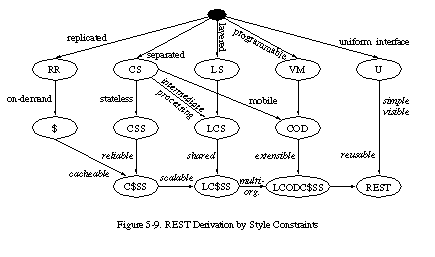
Sanjiva July 2008: "REST is now beyond the peak of the hype curve and is sliding down. Waay down."
March 2006: "Hype
could be a problem for REST if the 'industry' gets on board with it as
a commmercial factor that requires ticking off rather than some dorky
engineering stuff – 'Do they have REST? Check.' So will keeping an eye
out for land-grabbing on the term 'REST', so it remains a crisp
technical term "
REST hype helps no one. It makes discussing what are the good
tradeoffs to make sure "Web APIs" (a non-sequitor) are simulataneously
optimal for programmers and those to need to get something done, as
well as being stable interfaces over time for businesses and other who
need to take a long term view. That "REST" is hyped makes it
harder for people to make good decisions. I suppose what's funny now is
that "not doing REST properly" was almost a badge of honour a few years
back.
Sanjiva, June 2007: "Is that RESTful or not?" A good question from agoodpost, worth reading.
Are URIs used as the standard identifier for objects?
Does the design use a client server model?
Does the client store just the session state and the state of the application?
Does the server store just the state of the object?
Does the server provide well documented content types that can be selected dynamically?
Does the design support code on demand?
Do clients and servers communicate use a fixed set of methods, where each method's side effects and idempotence aspects are explicity defined.
Can caches be introduced without understanding the content, and the server/client states?
Is there more than one method?
Is the architecture layered, and can intermediaries be introduced between clients and servers without altering the client server interaction?
Stateless 1: Does each client-server interaction provide all the information needed for the network connectors between the client and the server to convey the request?
Stateless 2: Does each client-server interaction provide all the information needed to process the request on the server?
Stateless 2: Does each representation sent to the client provide the full state of the resource at that time?
Are all methods called on object URIs rather than URIs containing methods?
Those are some of the important design questions, once you get beyond surface things like URI formats and which formats are "open". Most or all of these need to be yes. Some are non negotiable.
Anne Thomas Manes: "The REST architectural style defines a number of basic rules
(constraints), and if you adhere to these rules, your applications will
exhibit a number of desirable characteristics, such as simplicity,
scalability, performance, evolvability, visibility, portability, and
reliability. [...] Non-RESTful POX applications violate these basic rules. First, they
don't define a URI for every resource. And second, they don't constrain
the interactions to the methods defined in the uniform interface.
Instead they define a single URL that represents an operation that can
be performed on any number of unnamed resources. Essentially they are
tunneling RPC calls through the URL"
Practical decisions that the REST architecture does not answer directly for service and system designers:
How should collections of objects be represented to clients?
How should a service be exposed?
What formats should be used?
Should I negotiate content types using URI parameters or headers?
How should authenticated access to and update of resource state be done?
How are resources instantiated?
How are private domain objects mapped to standard content types so as allow layering, implementation hiding and reduce dissonance between the internal object domain and the exposed on the wire representations?
How can resource state or an individual field be updated efficiently?
When should I use POST?
How can updates be idempotent, or cached?
Can I use parameter based identification and be consistent with REST?
How do I return partial versus full content? Should I? Specifically how do I represent data graphs to optimise the network architecture?
How can a client define a relationship between two objects?
How can I make good use of cookies?
Should I use forms post or a data structure such as XML/JSON to create objects?
What's the best way to send messages over HTTP?
How can I represent a queue?
I'm sure there are others.
Stefan Tilkov: "weirdly enough, building your own protocol using Web services is a lot
easier than understanding and using HTTP correctly. REST and RESTful
HTTP are not easy"
Sanjiva: "The world is inherently heterogeneous, even in languages and language
runtimes. There are 3 core platforms in existence today: C, JVM and
.Net CLR. Every language runs on top of one of those. Sticking your
head in the sand in only one of those will automatically limit the
market you can address."
I think you have to add javascript to that list; if the browser is not a globally deployed platform, then I don't know what is.
Ajax Patterns: RestfulService: "Being a broad architectural style, REST will always have different
interpretations. The ambiguity is exacerbated by the fact that there
aren't nearly enough HTTP methods to support common operations. The
most common example is the lack of a search method, meaning
that different people will design search in different ways. Given that
REST aims to unify service architecture, any ambiguity must be seen as
weakening the argument for REST.
Another issue is portability - while GET and POST are standard,
you may encounter browsers and servers which can't deal consistently
with DELETE, PUT, and others, if they're supported at all.
The main alternative to REST is RPC (see RPC Service]).
RPC is equally broad in definition, but the essential idea is that
services are exposed at procedures. You end up POSTing into verb-like
URLs such as /match/createMatch?matchId=1995 instead of RESTful, noun-like URLs such as /match/1995.
In fact, the difference is significant enough that some service
providers, such as Amazon, actually provide separate APIs for each. As
a general rule, any set of services could be exposed as either REST or
RPC; it's just a question of API clarity and ease-of-implementation.
Note also there is some overlap; as discussed in the RPC Service solution, RPC can still follow certain RESTful principles.
From an implementation perspective, REST and RPC differ in that
REST requires some explicit design, whereas RPC tends to follow
directly from the back-end software model. In the example, it's likely
there will be a MatchcreateMatch() method - that's just how most server-side software gets done. So it's a no-brainer to tack on a /match/createMatch
web service that mediates between the client and the back-end method.
In fact, there are many frameworks that will completely automate the
process for you.
With REST, there's no direct mapping between web service and
backend implementation - an impedence mismatch. You need to take a step
back and explicitly design your API to be RESTful. If you're following
feature-driven design, the API is the first thing you'll produce
anyway, since the design will be "pulled" by the needs of clients,
rather than "pushed" from the available technology. Once you've
designed the API, the web service implementation will effectively be a
kind of Adaptor (see Gamma et. al) to the back-end services."
Ironically the browser and HTML is one of the main reasons "non-REST" approaches to APIs are commonplace, especially the REST-RPC hybrid style - a lot of infrastructure and tooling is optimised for HTML form posting and not HTTP itself.
Diego Doval:"The Ning platform is one giant API that runs on what we call the core,
a collection of hundreds of servers and dozens of server types that
power the platform, presenting a homogeneous view of data and services
through a variety of HTTP-based REST APIs.
The Ning APIs are built using REST, but PHP applications running on
Ning have access to them through a thin layer of PHP code that
simplifies their use from within PHP. However, it is possible to use
the Ning REST APIs directly from PHP, it's just a little more
cumbersome."
Benjamin Carlyle: "The least common change in a REST architecture is to change the set
of methods. Why? Because it’s hard to know what to do when faced with a
method you don’t understand. You can deal with this to some extent by
returning a response to indicate that you didn’t understand, or only
partially understood. The client may be able to refashion the request
to take into account the protocol mismatch. However, method changes
require special and individual attention. There are few hard and fast
rules as to what strategy will work. This is one of the reasons why
methods in REST architecture tend to be so heavily restricted: Every
one must pull its weight, as reinventing or altering the set makes it
difficult to continue moving an architecture forward.
The other set of common changes is a restructure in server
URI-spaces. However, this is not a protocol change. The clients still
work. They just need to be reconfigured to point to the new URLs. Note
that this can be done in-protocol via redirection response codes.
In short, I think that SOA is fine and a proven technology when it
is possible to upgrade your whole architecture in one go to the new
protocols. I think that REST is the only proven technology when only a
tiny fraction of the overall architecture can be upgraded in a single
sitting. You can’t upgrade the whole Web. REST accommodates this.
Note that if you don’t have a definitive list of all content types
and all methods in use across your architecture, you aren’t doing REST
yet. REST uses standard methods and standard media types. It is still
up to your architecture to define the sets, but they must be defined
and controlled. Not only that, but they need to be defined and
controlled separately so that the set of methods and the set of media
types can evolve independently."
We need some more books that are written for programmers who need to get something done on the web and want to do so with as much principle as makes sense for them; along the lines of Effective Java, PoEAA or Ajax Patterns. My working title would be Patterns of Web Architecture, or "POWA" ;)


 Previous Topic