Friday I got up bright and early for the real highlight of the trip: a boat ride through the Aransas National Wildlife Refuge to to find Whopping Cranes. When I awoke Port A. was covered in fog, and driving to the dock was a little tricky. (I got lost twice.) By the time I found it, the fog was still pretty thick. I could see a raptor on top of a nearby telephone pole, but could at best guess it was some kind of Buteo, probably a Red-tailed Hawk but I’m not sure. Similarly I could only guess that the cormorant across the harbor was a Double-crested.
I noticed some of my fellow passengers had tripods and scopes. I’ve never brought a tripod on a boat before, but after checking with them, they seemed to think it would be possible to use, so I grabbed mine out of the rental car. Fortunately I hadn’t left it in my hotel room.
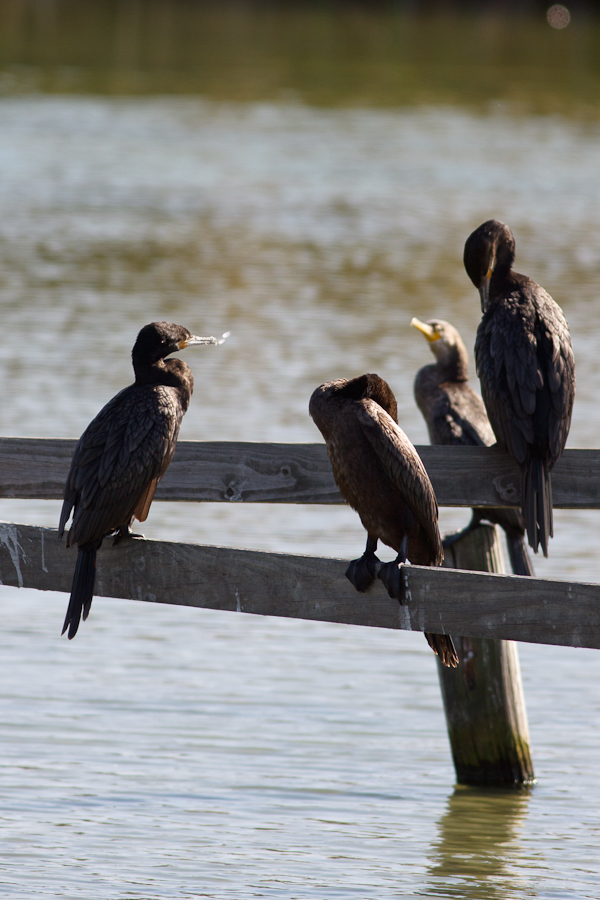
We traveled for quite while before the fog burned off, but once it did we started seeing birds, mostly gulls, a few terns, and not much else until we reached the refuge. Once we got there though there started to be some interesting birds on some small sandbars, and on about the third sandbar we passed there were cormorants of two sizes! That meant the smaller ones were Neotropic Cormorants, #524:
(FYI, these aren’t the first ones I saw. The boat was moving too fast and too far away to get good shots of those. These are from the Leonabelle Turner Birding Center later the same day.)
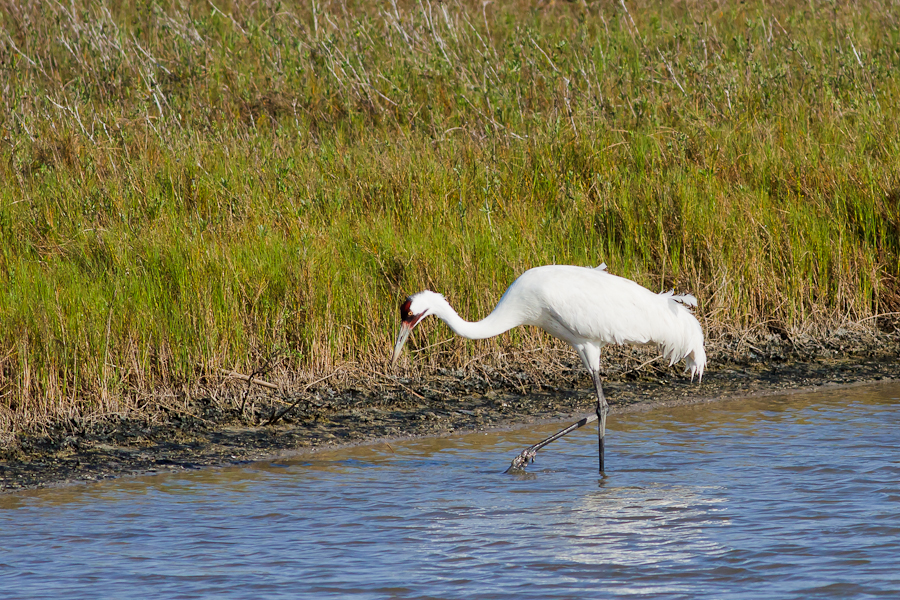
A little further into the refuge, we saw our first Whooping Crane, #525:
These impressive birds stand about 5 feet tall, and need about 300 acres per family, and have very specific habitat requirements. At the rate they’re increasing (about 4% per year) they’re about 25 years away from occupying all available habitat, and that’s assuming that a lot still in private hands on the Lamar Peninsula is preserved, and that increasingly warm winters don’t allow Mangroves to encroach into their existing habitat. They’ve recovered from their low point in the 1940s but it’s still touch and go. One bad oil spill (the Intracoastal Waterway goes straight through the Aransas Wildlife Refuge) could wipe out most of the population. There are efforts underway to establish new populations in Florida and Louisiana. So far these haven’t been hugely successful. There are also about 160 or so cranes in zoos around the world.
We spent a couple of hours enjoying the cranes as well as various shorebirds, herons, and egrets. Not long after the boat turned around and headed back to port a strange-looking Buteo flew over. The leader called it; White-tailed Hawk, #526 and a completely unexpected bonus for the trip:
From the boat we saw about 41 total species:
Gadwall
Northern Pintail
Redhead
Lesser Scaup
Bufflehead
Common Goldeneye
Red-breasted Merganser
Neotropic Cormorant
Double-crested Cormorant
American White Pelican
Brown Pelican
Great Blue Heron
Great Egret
Snowy Egret
Little Blue Heron
Tricolored Heron
Reddish Egret
White Ibis
White-faced Ibis
Roseate Spoonbill
Black Vulture
Turkey Vulture
Osprey
White-tailed Hawk
Red-tailed Hawk
Whooping Crane
Killdeer
American Oystercatcher
Greater Yellowlegs
Willet
Long-billed Curlew
peep sp.
Bonaparte’s Gull
Laughing Gull
Ring-billed Gull
Herring Gull
Caspian Tern
Forster’s Tern
Royal Tern
Sandwich Tern
Boat-tailed Grackle
Great-tailed Grackle
(I may have missed one or two other folks saw.)
We got back around noon. Afternoon trips included a jaunt around local hot spots and another boat ride in the harbor to look for Atlantic Bottlenose Dolphins. Lots of fun but no new life birds. Tomorrow: Fennessey Ranch and completely different habitat (plus more cranes.)


 Previous Topic