Very few people actually love the work they do. If it's somehow done magically with no concern of theirs, hey, they'd rather be fishing ! People have always tended to avoid work. Having somebody else to do one's job is the best strategy under the sun. Even for those who are not very sick of their job today, and pretend to be doing things, the less actual action - the better. Laziness is a much better driver than fictional pursue of productivity, urge for business success or corporate loyalty.
Now, people don't need software at all. Like I said, they need their job done, preferrably with no load on themselves. But software was giving such promises about how much easier it would be (if you purchase product X) since day one. Not that many still believe that new version of Microsoft Word will boost their productivity, but hey, this is how documents are prepared in 21st century, ain't it ? It's just that you install it, boom ! and your documents "practically manage themselves" (a ridiculous sentence if you ask me).
Therefore users dream of software with one big button reading "Get my job done now" (even then there would be some moaning about how much hassle it is to push it). It is indeed crucial to design software in such a manner that it requires as little user intervention as possible. But doing so is very tricky.
Let's say we are developing an accounting package. The first problem we are going to face is ubiquitous lack of knowledge. It probably wouldn't surprise you the least that someone with degree in CS knows nothing of accounting, leave alone specific customer's business practices. What would surprise you for the first few times is that the users themselves don't know what they are doing, no matter if they've got a degree in finance.
We are likely to see that everyone knows a little bit but nobody sees the big picture. "It's just how it's done here, that guy over there probably knows something" is the sort of speech you may hear. Blind leading the blind, at its worse.
A good business analyst can save the day, no doubt. Since a good business analyst essentially is a person to some extent trained in both areas, experienced in exactly that kind of projects and (which is crucial) clever, fluent and clear in his thoughts and talks, he could definetely talk things out.
But the business analyst will actually be busy recognizing an elephant from descriptions given by three blind wisemen. Or, sorting out all the quirks of the customer's business practices, which is essentially the same thing. Even if (and it's a big if) he succeeds all the team gets is a 10 sq. ft. diagram with lines going in all directions. Better understanding, perhaps, but of what ? And this is where the second problem hits - ugly and tangled business practices.
Well, the customer is always right and all that, but what's the point in one-to-one mapping software functions to existing business practices ? Nobody understands how it works, I see. Now you have software that automates that ! I mean, it's just outrageous. You take a can of worms, sort of peek into it, then, using whatever perfect (huh ?!) software development process, implement the automated can of worms and hand it over to the customer.
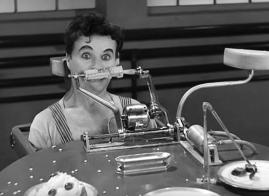
"Eeew !" - that's what the user says - "I thought this software thing would be simpler ! Where is the "Get my job done now" button ?!" Oops, there is no such button. What you get is a button for every chaotic activity you have performed before the software extravaganza started.
And so my point is - for a business to benefit from software automation, it must work well enough even before and without any software. Chaos cannot be automated, that's what I say. As there is hardly a perfectly organized business out there, well, it needs to be changed before it can be automated.
The good news is - those two processes can be performed in parallel and greatly support each other - straightening (uh, streamlining is so much a buzzword) the existing business practices, and analysis of the same for the sake of software development. If there is a perfect moment for changes, it's now - there is a lot of efforts put into it from the software developers camp, and people genuinely interested in understanding and making changes will be around, not the stupidest people too. All the customer needs is to allocate decent resources and get ready to change.
The bad news is - a customer is more likely to remain heavy and unresponsive. "There, we've paid you, now where is our button ?" Still, as you know, changes come, now or later, and it's better to change it right now than to postpone.
To conclude, I believe we as software developers should be working not just on software but also on improving our customer's business rules, it's in our own best interest. Moreover, we should be pushing the customers to changes, not just accepting their requirements.


 Previous Topic


