This post originated from an RSS feed registered with Agile Buzz
by Glenn Vanderburg.
Original Post: Bridges and Software
Feed Title: Glenn Vanderburg's Software Blog
Feed URL: http://www.vanderburg.org/cgi-bin/glv/blosxom/Software?flav=rss
Feed Description: Glenn Vanderburg's blog about software development
(I sent this to the NFJS speakers’ mailing list last week, and Ben
Galbraith suggested I repost it here.)
Every now and then I hear someone compare software development to bridge
building. (Bridge building, of course, is just a placeholder here for
"real engineering," which in the speaker’s mind is much
cleaner and more manageable than the current messy state of software
development.) Sometimes it’s "software development isn’t
like building bridges," while on other occasions it’s
"software development should be more like building bridges." In
either case, though, the implication is clear: bridge building is
predictable, rote, unexciting, very manageable work, and software
development is not. The only difference is whether the speaker likes
software development the way it is, or wishes it could be different.
I think both positions are misinformed. And no, I’m not about to pull
out my magic prescription for how to solve all the software
industry’s problems by making it more like bridge building. In my
experience, software developers tend to have an idealized, unrealistic view
of what "real engineering" is like. Sure, some kinds of bridges
are so well understood by now that there’s very little risk involved;
freeway overpasses and the like are churned out regularly and routinely (in
much the same way that simple CRUD applications, whether web- or
desktop-based, are usually safe bets for even inexperienced development
teams). But from what I’ve learned, bridge building in general is a
lot more like modern software development than most people realize. And I
think the software industry can learn some lessons from the history of
bridge building.
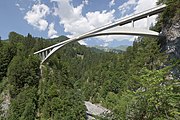
Maillart was seeking new designs that would take advantage of the
properties of a new material: reinforced concrete. It had been in use for
some time, and builders had figured out how to work with it, but Maillart
realized that reinforced concrete had unique properties that would permit
the use of new forms, resulting in significant savings (due to reduced
material costs).
The formal methods used by civil engineers at the time weren’t up to
the challenge of analyzing these structures (known today as "hollow
box arches" and "deck-stiffened arches"). Maillart verified
the designs empirically, by building models, rolling barrels full of
concrete over them, etc. etc. The civil engineering establishment of the
day vilified him as a charlatan who was endangering lives and cheating his
customers by building bridges that would fall down. But he got customers
anyway, because his designs were much, much cheaper to build. (The fact
that they were strikingly beautiful didn’t hurt.)
Another engineer of the time was Leon Moisseiff, a
strong proponent of formal methods and the developer of "deflection
theory," at the time the state of the art in mathematical analysis of
suspension bridges. Moisseiff designed a bridge intended to be a showpiece
for the power of deflection theory. It was the Tacoma
Narrows bridge. After its famous collapse, other bridges that had been
designed with Moisseiff’s assistance (such as the Golden Gate) were
retrofitted with stiffening trusses. It turned out that deflection theory
was deeply flawed in a way that nobody had yet realized.
One of Maillart’s bridges did fall down … after being buried
under an avalanche. One was demolished because more capacity was required.
The rest are still in use, and the forms he pioneered are now standard
design taught to civil engineers. The math eventually caught up with
Maillart’s methods. As the story I linked to above notes, Maillart is
an inspiration to the current superstar of bridge design, Santiago
Calatrava.
I think there are some important lessons here for the software profession.
The lesson is definitely not that "real engineering" is a
mechanistic, purely construction-oriented process, which is the lesson that
is usually assumed when software is compared to bridges.
Note: I have at best an interested layman’s knowledge of the history
of bridge engineering. Sources include Henry Petroski’s wonderful Engineers
of Dreams: Great Bridge Builders and the Spanning of America for
information about Moisseiff, and David P. Billington’s article "The
Revolutionary Bridges of Robert Maillart" (from the July 2000 edition
of Scientific American). For what I believe to be the best description of
the true relationship between software development and other engineering
disciplines, I encourage you to read "What
is Software Design?", Jack Reeves’ brilliant essay.
>> The lesson is definitely not that "real engineering" is a mechanistic, purely construction-oriented process, which is the lesson that is usually assumed when software is compared to bridges.
I don't believe that the statement of what is the Lesson is correct, nor that this definition of the Lesson is what is assumed when comparing software to Real Engineering.
For one thing, the number of fallen down bridges as a fraction of bridges is arguably infintesimal compared to the same fraction for "major software systems". That an intuitive civil engineer could make a design that worked, while an analytical civil engineer made one that failed, does not, ceteris parabus, invalidate the analytic approach.
For another, the comparison is usually, "if they built bridges the way they build software, they'd all fall down in a week". This story is not a contradiction to that expression. The expression is that software is ad hoc and undisciplined, real engineering is studied and disciplined.
Only if bridge builders gave up their slide rules and FEA software and used napkin notes instead; and had fewer collpases, would there be a contradiction to the common expression.


 Previous Topic