This post originated from an RSS feed registered with Agile Buzz
by Martin Fowler.
Original Post: SelfInitializingFake
Feed Title: Martin Fowler's Bliki
Feed URL: http://martinfowler.com/feed.atom
Feed Description: A cross between a blog and wiki of my partly-formed ideas on software development
One of the classic cases for using a TestDouble is
when you call a remote service. Remote services are usually slow and
often unreliable, so using a double is a good way to make your tests
faster and more stable.
When you're querying a remote service, you need to find a way to
load the expected data into your double. One way to do this is to
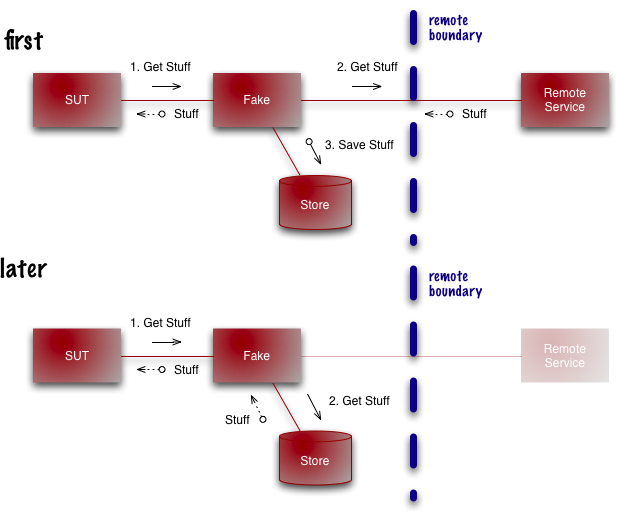
use what I'm dubbing a self-initializing fake. The basic plan is
simple. The first time you call the fake it passes the call onto
the actual remote service, and as it returns the data it takes and
saves a copy. Further calls just return the copy. In a sense this is
like a cache, but with the important difference that there is no
attempt to handle cache invalidation, which is handy as that's one
of the TwoHardThings.
I've called this a fake, as that seems the closest fit from the
various varieties of test doubles. The other reasonable alternative
is a stub, but the distinction here is that a stub needs setting up
when you build the fixture, while fakes are autonomous.
The interesting thing about a self-initializing fake is how you deal
with situations where the remote service changes it's response.
One time I saw this approach was with a database controlled by
another application. In this case the data did change,
frequently. This is unhelpful for tests, because automated tests
rely on getting the same answers to the same questions. But usually
tests don't care whether the data is up to date or not, so saving an
old value worked just fine.
I ran into this again recently while chatting with my colleague
Josh Price. In his case the remote data was supposedly static, but
occasionally there were changes, which would imply that the system
he was developing needed to change - usually to handle formatting
issues. In this case he had a special test suite that would get all
self-initializing fakes to call the remote service and check that they
returned the same value that was saved.
In this case early stages of their build pipeline ran against the
fake, and the last (slowest) stage ran against the service
itself. One interesting problem was that the remote service required
some unimportant parameters which changed from call to call but
didn't alter the results. These were stripped out of the URL when
the fake looked the values up from the store.
(Thanks to Josh Price, Darren Cotterill, and Gerard Meszaros for
their help with this piece.)


 Previous Topic