This post originated from an RSS feed registered with Agile Buzz
by Martin Fowler.
Original Post: Bliki: IntegrationContractTest
Feed Title: Martin Fowler's Bliki
Feed URL: http://martinfowler.com/feed.atom
Feed Description: A cross between a blog and wiki of my partly-formed ideas on software development
One of the most common cases of using a TestDouble is
when you are communicating with an external service. Typically such
services are being maintained by a different team, they may be
subject to slow, and unreliable networks, and maybe unreliable
themselves. That's why a test double is handy, it stops your own
tests from being slow and unreliable. But testing against a double
always raises the question of whether the double is indeed an
accurate representation of the external service, and what happens
if the external service changes its contract?
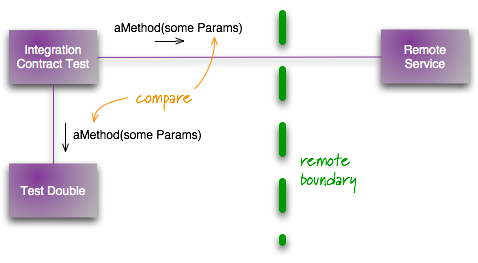
A good way to deal with this is to run your own tests against the
double, but to periodically run a separate set of integration
contract tests that checks all the calls against your test doubles
return the same results as a call to the external service would. A
failure in any of these integration contract tests implies you need
to update your test doubles, and probably your code to take into
account the service contract change.
These tests need not be run as part of your regular deployment
pipeline. Your regular pipeline is based on the rhythm of changes to
your code, but these tests need to be based on the rhythm of changes
to the external service. Often running just once a day is plenty.
A failure in an integration contract test shouldn't necessarily
break the build in the same way that a normal test failure would. It
should, however, trigger a task to get things consistent again. This
may involve updating the tests and code to
bring them back into consistency with the external service. Just as
likely it will trigger a conversation with the keepers of the
external service to talk about the change and alert them to how
their changes are affecting other applications.
This communication with the external service supplier is even
more important if this service is being used as part of a production
application. In these cases an integration contract change may may
break a production application, triggering an emergency fix and an
urgent conversation with the supplier team.
To reduce the chances of unexpected breaks in integration
contracts, it's useful to move to a Consumer
Driven Contracts approach. You can facilitate this by letting
the supplier team have copies of your integration contract tests so
they can run them as part of their build pipeline.
When testing an external service like this, it's usually best to
do so against a test instance of the external service. Occasionally
you'll have no choice but to hit the production instance, at that
point you'll need to talk to the suppliers to let them know what's
happening and be extra careful with what the tests do.
Integration contract tests check the contract of external service
calls, but not necessarily the exact data. Often a stub will
snapshot a response as at a particular date, since the format of the
data matters rather than the actual data. In this case the
integration contract test needs to check that the format is the
same, even if the actual data has changed.
One of the best way to build these test doubles is to use a SelfInitializingFake.


 Previous Topic