This post originated from an RSS feed registered with Agile Buzz
by Martin Fowler.
Original Post: Bliki: CertificationCompetenceCorrelation
Feed Title: Martin Fowler's Bliki
Feed URL: http://martinfowler.com/feed.atom
Feed Description: A cross between a blog and wiki of my partly-formed ideas on software development
Most of my friends and colleagues are very negative about
certification schemes in software development, a disdain that I
share. This doesn't mean that I think that certifications in
software are bad by definition, just that almost every one we see
fails a basic test.
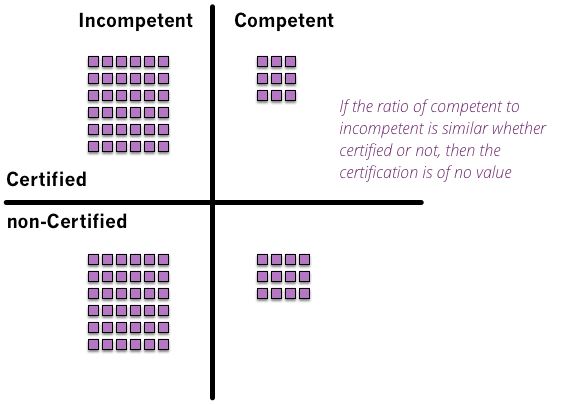
For a certification to be useful, it needs a correlation with
competence in the thing that it certifies. So if Alice has a
certification in, say, clojure programming; then there should be a
high probability that Alice is a competent clojure programmer. High
probability isn't a guarantee, but it should be significantly higher
than the general programmer population. The reason we have disdain
for most software certification programs is because we've not seen
such a correlation (indeed sometimes we feel there's a negative correlation).
Furthermore, the fact that most certification schemes lack this
correlation means that I tend to judge such schemes as guilty until
proven innocent. This includes new schemes, which is why I've been
deeply wary of getting involved in new certification programs.
A useful certification scheme, one with a respectable competence
correlation, would be a Good Thing - particularly if it had a
broad focus. Such a scheme would make it easier to hire someone for
a task. At the moment the only way you can tell if someone is a good
programmer is to find other good programmers to assess their
ability. Such assessment is difficult, time-consuming, and needs to
be repeated by each hiring organization. If you are
a non-programmer looking to hire someone, such an assessment is
particularly daunting.
What makes the situation worse is that certification schemes,
even the useful ones, are prone to corruption. If you can get
recognition for a certification scheme, there is a good money-making
opportunity there: courses, assessments, books etc. Sadly there
doesn't seem to be much correlation between a certification's ability
to make money and its usefulness.
Is it reasonable for a competent person to acquire a useless
certification? I wish I could answer no, but the reality is that a
certification is often used as an entry gate, even if it is
useless. As a result competent people often need a useless
certification in order get an interview. (I suppose you could argue
that this makes the certification useful, at least in an economic
sense, but I prefer to stick with competence correlation.)
I do think that if you hold a useless certification, you should
never try to imply that it means anything. Indeed you should take
what opportunities you can to educate people about its
uselessness. Lousy certifications are a canker to our profession and
we should work as much as we can to remove them.
Many people I know and respect offer certifications as part of
their training courses. This is bad in that it reinforces the canker,
but on the whole I sympathize. Many organizations will only send
people on a course if it comes with a certification, and I think
it's reasonable to offer a certification to help bring people to a
valuable course. Furthermore, as I discussed above, it is reasonable
for people to get a useless certification, and I would rather them
gain such a certification in a useful course.


 Previous Topic