This post originated from an RSS feed registered with Agile Buzz
by Martin Fowler.
Original Post: Bliki: SemanticConflict
Feed Title: Martin Fowler's Bliki
Feed URL: http://martinfowler.com/feed.atom
Feed Description: A cross between a blog and wiki of my partly-formed ideas on software development
Those who hear my colleagues and I talk about
FeatureBranch know that we're not big fans of that
pattern. An important part of our objection is the observation that
branching is easy, but merging is hard. One argument we hear from
time to time is that modern VersionControlTools make
merging sufficiently easy that feature branching is worthwhile.
Certainly modern tools do a much better job of merging than in my
youth. A good example of this power is merge-through-rename
which can properly merge the situation where I change some of the contents of
lorem.rb, while Jez changes its name to
ipsum.rb.
This is all very well, but it only solves textual conflicts and does
not help with semantic conflicts. By a semantic conflict I mean a
situation where Jez and I make changes which can be safely merged on
a textual level but cause the program to behave differently
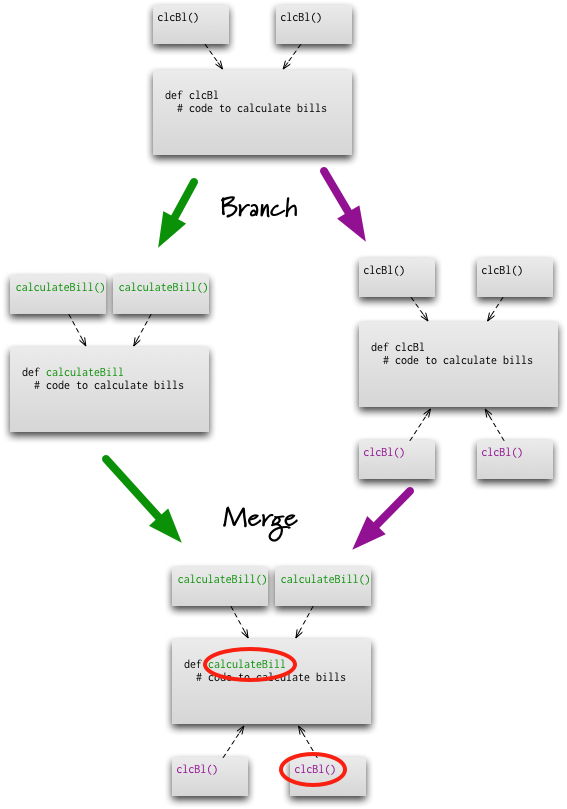
The simplest example is that of renaming a function. Say I think
that the method clcBl would be easier to work with if
it were called
calculateBill. With modern refactoring tools this is
trivial: just press Shift+F6, type the new name, and the tool then
changes all the callers. The problem appears, however, if Jez adds
more calls to this method on his feature branch. When the two get
merged, the textual merge will work fine, but the program will not
run the same way.
A method rename is a simple example, and is also easy to find in
a statically typed language as it will fail to compile. But there
are plenty of subtler semantic conflicts that won't merge so
cleanly. Let's imagine I'm looking at that
calculateBill method and realize that as well as
calculating the bill, it also sends off accounting entries to the
accounting system. I don't like the side effect, so I pull it
out into a separate notifyAccounting method. I can then
find all the callers of calculateBill and add a call to
notifyAccounting. But Jez doesn't know about that in
his branch.
So the first point here is that however powerful your tooling is,
it will only protect you from textual conflicts [1]. The particularly
annoying point is that semantic conflicts are harder to spot and
harder to fix.
We can't automatically resolve semantic conflicts. Maybe some day
tools will be able to tackle some of them, but I suspect some gnarly
ones will always be with us - at least until computers can read our
mind and automatically deduce our intentions. There are, however, a
couple of strategies that can significantly help us deal with them
The first of these is SelfTestingCode. Tests are
effectively probing our code to see if their view of the code's
semantics are consistent with what the code actually does. If Jez is
expecting certain things to happen with the code he's calling and
has tests for that, then they will break when he integrates. It's
not a perfect response, of course. Tests can never be perfect, but
they catch lots of semantic conflicts in practice. They also don't
help with fixing the conflict once you've discovered it, but finding
it is a big part of the battle
The other technique that helps is to merge more often. Jez's
difficulties are much less if he discovers my change in a few hours
rather than in a few days. That way he's no longer building a lot of
code on the old semantics. This is why we are such big fans of continuous
integration.
There seem to be two groups of people who promote the notion of
tools make feature branching tolerable. One is purveyors of
"enterprise grade" VCSs. We don't really care about them. The other
group is fans of DVCSs (Distributed Version Control Systems). I get
a bit more concerned about the latter group. Often people try to
justify DVCSs based on how they make feature branching easy. But
that misses the issues of semantic conflicts [2]. There are lots of good
reasons to use a DVCS, so there's no reason to couple a good tool to
a problematic technique.
1:
And if we change the exact same text, the merge tool usually
can't help either unless you have something like git rerere.
But that problem is much smaller than semantic conflicts.
2:
If your features are built quickly, within a couple of days,
then you'll run into less semantic conflicts (and if less than a
day, then it's in effect the same as CI). However we don't see
such short feature branches very often.


 Previous Topic