This post originated from an RSS feed registered with Agile Buzz
by Martin Fowler.
Original Post: Bliki: gotoAarhus2011
Feed Title: Martin Fowler's Bliki
Feed URL: http://martinfowler.com/feed.atom
Feed Description: A cross between a blog and wiki of my partly-formed ideas on software development
goto (formerly known as JAOO) has long been a favorite conference
of mine. They've done a great job over the years of keeping a high
standard of content combined with an efficient and friendly
organization. So while my over-consumption of conferences has
generally led to conference-phobia, I still feel a sense of pleasant
anticipation when heading off for the somewhat complicated trip to
Aarhus.
My work this year was a couple of co-presented tutorials: with
Jez Humble on Continuous Delivery and with Rebecca Parsons on
Evolutionary Architecture. While the former is pretty well treaded
in, the evolutionary architecture was our first attempt to do this -
but I was pretty happy with how it worked out. I'm thinking Rebecca
will be doing this tutorial more widely next year and it's well
worth taking a look.
A number of session stuck in my mind. One that got lots of
outside attention was the keynote on Google Dart - a new language
and virtual machine presented by Lars Bak and Gilad Bracha. In
essence Dart is primarily intended for building in-browser
javascript applications. You can deploy an application either by
compiling to javascript, or by source or a compiled binary to be run
by the Dart virtual machine. Compiling to javascript allows for
maximum interoperation with current browsers, but sending a binary
to the Dart VM speeds up load time for a browser that has a Dart VM
installed. Google have open-sourced both the VM and language, which
should minimize the friction in including Dart in browsers.
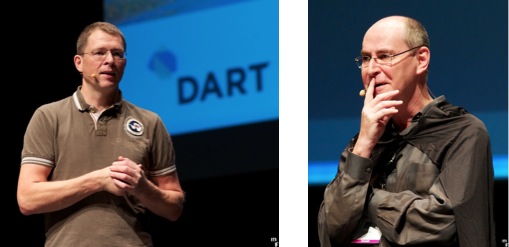
Lars
Bak and Gilad Bracha introduced the Dart programming language
The language is a conservative object-oriented language, with a
C-like syntax and single-inheritance object model. Its most
immediate unusual feature is its approach to typing. It is a
dynamically typed language, but you can add types to the source.
These types do not alter the output of the compiler but are checked
and will generate warnings if there are type errors. In addition the
types can provide information for IDEs to help with things like
intelligent completion. (I liked Gilad's quotable line: "type
checkers are lobotomized theorum provers".)
I haven't looked at Dart beyond what was presented in the
keynote, but based on that I liked what I saw. I'm convinced there
is a need to replace javascript. While it is a language with some
powerful features, it is an ugly language that is difficult to use
well. A colleague summed it up well recently - he was on a project
that used javascript well, but ended up regretting not using CoffeeScript
instead because he felt that even well-written javascript was not
clear enough code. Dart looks much cleaner and its deployment
approach gives some clear benefits for using a Dart VM while
maintaining compatibility for older browsers - which is vital as
javascript will be around for many years to come.
Another session that was an harbinger of the future was Kresten Krab Thorup's talk on using
Riak to store medication
prescriptions in Denmark. The existing system is built on a MySQL
database, but they are concerned about its scalability. Riak's
peer-to-peer distribution design offerred them a better model for
running the database across multiple centers. This is a theme that I
think will grow, relational databases were built with a mindset of a
single big server, but increasingly we are seeing clusters of
commodity servers - and thus a rethink of data storage. This
prescription information is well suited to this storage approach as
data access is primarily getting a full list of prescriptions for a
patient - which makes a natural aggregate for the system.
I also found their migration approach interesting. The system
naturally suits itself to EventInterception which allowed
them to use the incoming events to populate both the MySQL and Riak
stores together, testing that the Riak system could handle the
update load while still running off the MySQL system.
Over the last year or so it's clear that the DatabaseThaw
is moving slowly but steadily. Increasingly people are beginning to
realize that data storage is no longer automatically the province of
SQL databases, but is now a choice that demands thought. No single
data storage solution is the right one for all cases, so you have
pick the one that fits your circumstances - but the pay-off is a
much simpler and thus more productive programming model and/or
better horizontal scalability. It was frustrating to talk to another
group of people
hampered by an inappropriate use of relational technology when
their customer would have been much better served by a NOSQL
option.
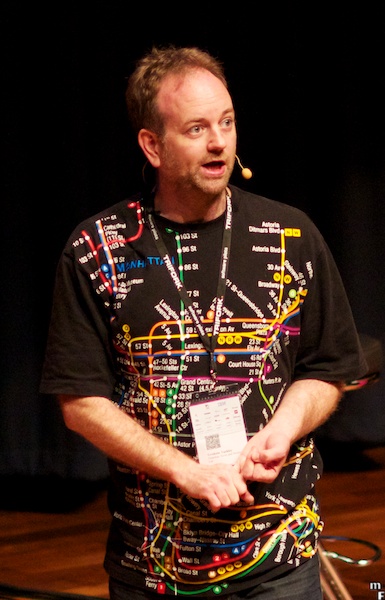
Graham Tackley feeling happy with Scala
I also caught up with Graham Tackley and their use of Mongo at
The Guardian. It appears that Mongo has worked out really well for
them and is a strong choice for their future work. I caught Graham's
talk about their use of Scala for new projects and their positive
experiences of the language as a step forwards for developing from a
java environment. I've heard a few such accounts now, enough to feel
that Scala is a serious option for organizations developing on a JVM
platform.
A rare chance to photo both authors of the award winning
Continuous
Delivery book (Jez Humble and Dave Farley) - Dave was there talking about his work on LMAX
A final session I'll mention was Tudor Girba's talk about Moose - a tool for
assessing the quality of a code base. I've heard on and off about
Moose for a few years. Erik Dörnenburg has been talking about it as
we've expanded our work in system health checks. Tudor's talk was
quite the virtuoso performance, sufficiently polished that it was
up there with the best of Neal Ford's presentations.
The tool also was quite fascinating. It's hard to tell from a
very polished demo how easy it is to use a tool, and Moose is
clearly a very sophisticated tool (and such tools are often
difficult to learn). What struck me most about it was not so much
its obvious applicability to assessing code, but its embodiment of
the a general philosophy of tools that was central to much of the
thinking of the Lisp and Smalltalk communities, but has since
withered.
This philosophy sees the user of a tool as someone who
is expected to tinker with the very guts of the tool in order to
mould it to her needs. To acheive this, the tool not just opens up its
source code for inspection and modification, but also makes it easy
to make enhancements with rapid feedback. The most common example
that springs to my mind is emacs - which encourages a user to treat
it as a malleable tool. Moose is written in Smalltalk, and that same
philosophy came through strongly in Tudor's talk - quickly allowing
you to build first class features into the tool by implementing new
functions in a matter of minutes.
Such malleable tools haven't caught on that much. They do
require an eagerness from the user to learn how to make the tool
truly sing, but this effort comes with the reward of a tool that can
truly be tailored to an individual's needs.


 Previous Topic