This post originated from an RSS feed registered with Agile Buzz
by Martin Fowler.
Original Post: Bliki: TestCoverage
Feed Title: Martin Fowler's Bliki
Feed URL: http://martinfowler.com/feed.atom
Feed Description: A cross between a blog and wiki of my partly-formed ideas on software development
From time to time I hear people asking what value of test coverage (also
called code coverage) they should aim for, or stating their coverage
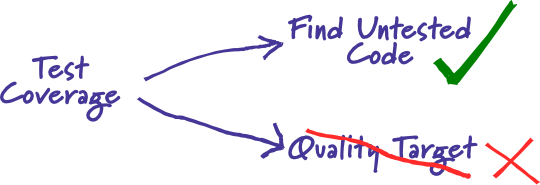
levels with pride. Such statements miss the point. Test coverage is
a useful tool for finding untested parts of a codebase. Test
coverage is of little use as a numeric statement of how good your
tests are.
Let's look at the second statement first. I've heard of places
that may say things like "you can't go into production with less
than 87% coverage". I've heard some people say that you should use
things like TDD and must get 100% coverage. A wise man once
said:
I expect a high level of coverage. Sometimes managers require
one. There's a subtle difference.
-- Brian Marick
If you make a certain level of coverage a target, people will try
to attain it. The trouble is that high coverage numbers are too easy
to reach with low quality testing. At the most absurd level you have
AssertionFreeTesting. But even without that you get lots
of tests looking for things that rarely go wrong distracting you
from testing the things that really matter.
Like most aspects of programming, testing requires
thoughtfulness. TDD is a very useful, but certainly not sufficient,
tool to help you get good tests. If you are testing thoughtfully and
well, I would expect a coverage percentage in the upper 80s or 90s.
I would be suspicious of anything like 100% - it would smell of
someone writing tests to make the coverage numbers happy, but not
thinking about what they are doing.
The reason, of course, why people focus on coverage numbers is
because they want to know if they are testing enough. Certainly low
coverage numbers, say below half, are a sign of trouble. But high
numbers don't necessarily mean much, and lead to ignorance-promoting
dashboards. Sufficiency of testing is much more complicated
attribute than coverage can answer. I would say you are doing enough
testing if the following is true:
You rarely get bugs that escape into production, and
You are rarely hesitant to change some code for fear it will
cause production bugs.
Can you test too much? Sure you can. You are testing too much if
you can remove tests while still having enough. But this is a
difficult thing to sense. One sign you are testing too much is if
your tests are slowing you down. If it seems like a simple change to
code causes excessively long changes to tests, that's a sign that
there's a problem with the tests. This may not be so much that you are
testing too many things, but that you have duplication in your tests.
Some people think that you have too many tests if they take too
long to run. I'm less convinced by this argument. You can always move
slow tests to a later stage in your deployment pipeline, or even pull
them out of the pipeline and run them periodically. Doing these things
will slow down the feedback from those tests, but that's part of the
trade-off of build times versus test confidence.
So what is the value of coverage analysis again? Well it helps you
find which bits of your code aren't being tested. [1] It's worth running
coverage tools every so often and looking at these bits of untested
code. Do they worry you that they aren't being tested?
If a part of your test suite is weak in a way that coverage can
detect, it's likely also weak in a way coverage can't detect.
1:
By "you" here I mean the people writing the tests. Coverage is of
little value to management since you need a technical background
to understand whether the tests are good or whether the uncovered
code is a problem.


 Previous Topic