This post originated from an RSS feed registered with Agile Buzz
by Martin Fowler.
Original Post: Bliki: EditingPublishingSeparation
Feed Title: Martin Fowler's Bliki
Feed URL: http://martinfowler.com/feed.atom
Feed Description: A cross between a blog and wiki of my partly-formed ideas on software development
In my conversations with ThoughtWorks project teams over the last
year or so, a regular theme has been the growing impact of content
management systems (CMS). They aren't usually seen as helpful,
indeed there is a clear sign that they are becoming a worryingly
invasive tool - used for more than their core purpose in such a
manner that they hinder overall development.
Amongst the other irritations, a common failing is that they keep
one copy of each article[1]. This single copy
is edited as part of creating the content and published to readers
(usually on some kind of state-change flag).
The idea of keeping a single copy of some piece of data is a
common one. It's the underlying principle behind the relational
concept of normalization, and enterprise architects often try to
ensure that critical data has a single authoritative copy.
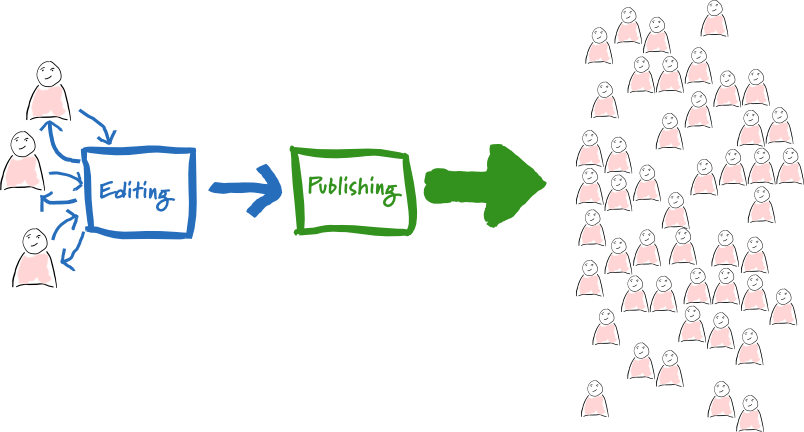
Yet for a CMS there's a clear downside - the data access patterns
for editing and publication are very different. Editing involves
small number of people frequently accessing the article, doing both
reads and updates. Publishing involves many more people (we hope)
accessing the article, but all doing reads. There are some edits
done to fix problems in published articles, but these are far fewer
than the reads and are from a well-controlled group of people.
With two such different access paths, a few CMSs keep separate
copies of the articles, controlled by relatively independent
modules. The editing module is geared around the frequent updates,
it provides support for editing, tracking changes and monitoring the
workflow of the editing process. When an article is published it's
copied over the publishing module.
The publishing module treats the article as largely read-only,
updated rarely and only by the editing module. Consequently the
publishing module is designed around serving that article to a large
number of readers. At the least this involves a different
configuration of the data storage. The publishing module can be
freely replicated across many nodes in a cluster, while it's usually
better for the editing module to be centralized on a single node.
There's also an argument for different data storage technology,
allowing each module to use something appropriate to its access patterns.
The articles can also be stored in different formats. Often
articles are edited in one form but published in another, such as
editing in markdown and publishing in html. In this case the editing
module should store the markdown form while the publishing module
stores html. The publishing module can also do some page composition
work on the stored copy. So if you have a static header, this can be
added to the stored article's html when the article is published,
saving the effort of recomposing it for every read.[2]
Separating these modules can also help with the editing workflow.
Often people want to preview changes before publishing to the world,
this is easy to do with the separation because you can publish to a
private publishing module in a staging area. This can nicely finesse
otherwise awkward logic to figure out what to publish from single
storage.
User-generated content does add something of a wrinkle to this
approach. A wiki, which is entirely user-generated, is going to have
a larger and less-well controlled group of editors than a curated
site. Similarly reader comments will come from a wider range of
writers. But even with user-generated content you should get many
more readers than writers, so it makes sense to separate handling updates
from serving published pages.
Teams that use the rare systems that support editing-publishing
separation find it works very well and most teams who use tools that
don't have this style think it would improve things. If you're
evaluating a CMS, or building one for your own needs, you should
certainly consider editing-publishing separation as a key feature to
look for.
1:
I'm using "article" here to mean any item of content that the
CMS manages.
2:
This does mean that any change to the header would require all
the published articles to be rebuilt. Usually this would not be
an issue compared to composing the page for each read.


 Previous Topic