This post originated from an RSS feed registered with Agile Buzz
by Martin Fowler.
Original Post: Bliki: CommunalDashboard
Feed Title: Martin Fowler's Bliki
Feed URL: http://martinfowler.com/feed.atom
Feed Description: A cross between a blog and wiki of my partly-formed ideas on software development
With the growing interest in data analytics and visualizations,
we're seeing more effort put into interesting visualizations that
allow people to draw insight from data floating around in an
organization. Most of these dashboards are aimed at individual
usage, but there is a growing tendency to use them for a more
communal purpose.
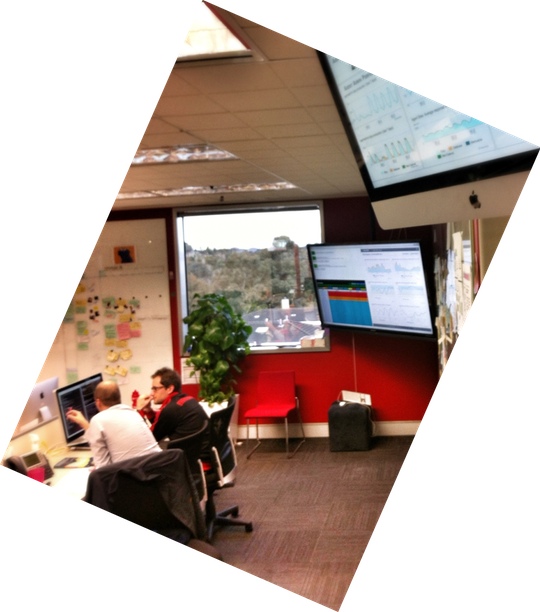
REA-Group in Australia are extensive
users of communal dashboards within their development team
areas (photo: Nigel Dalton)
The idea is to have display monitors in semi-public places within
an organization. This allows many people to see the information in
the communal dashboard. This is less about helping people make
decisions, more about educating people about what's happening,
providing background information and context for their regular work.
One person put it as creating an emotional engagement with how the
business is running. People in the agile software
community will naturally see these as a form of information
radiator[1].
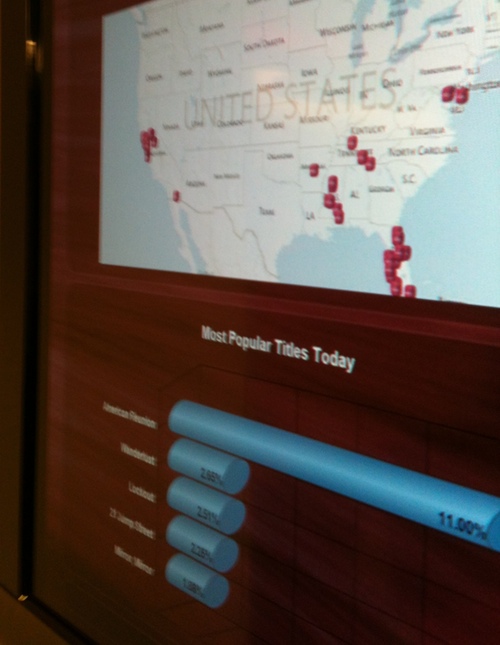
An example of this comes from Redbox, a company that operates
vending machines of DVD rentals in North America. Their dashboards
data that includes a running count of the total number of rentals ever made, a
table showing the top movies rented recently, and a speedometer
showing rentals per second. The information is shown on various
displays around the office - the rise of cheap flat-screen monitors
has made this a much less costly exercise than it used to be.
Part of Redbox's communal dashboard (photo: Chris Kapcar)
Imaginative presentations help to grab attention. One of Redbox's
displays was pushpins on maps indicating the locations where new
Redbox machines were opened in the past 7 days. As the day and week
drew on you could see where new Redbox machines were sprouting up.
Another company sells visually unique products (similar to houses
or cars). It used a tetris like falling icon display with a photo of
the product when it was sold, inspired by Apple's app
wall.
Web browsers, in a full-screen mode, are usually a good choice
for this. Increasingly libraries are available that allow dynamic
visualizations to be generated in javascript and HTML 5.
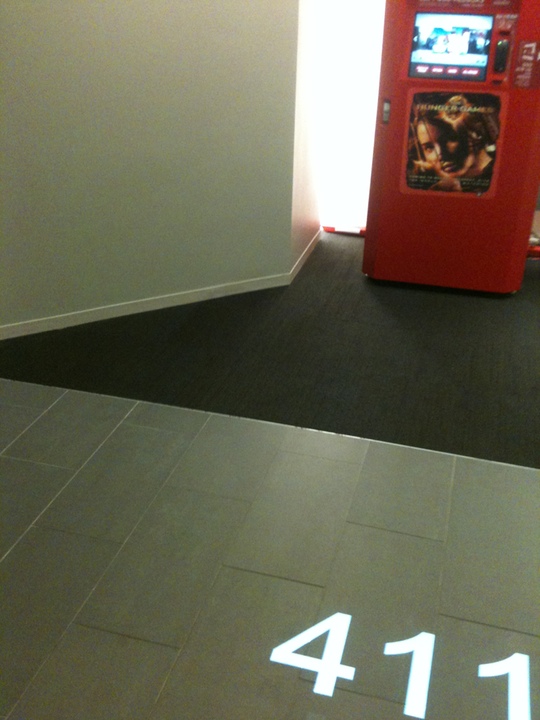
The display medium can also be more imaginative. Redbox
projects a running counter of the day's rentals onto
the floor outside their main lobby. (photo: Chris Kapcar)
These are crude visualizations, they can't show much detail, nor
can they be interactive. However they can generate an awareness of
what's happening, creating a connection between office staff and a
otherwise distant day-to-day activity. Visiting business partners
are other target viewers. The display of information on a screen
like this makes a natural entry point for a conversation that can
help oil some deal-making.
It may not be clear how much influence these dashboards produce.
One heavy user of these commented that they didn't seem to engage
people, they weren't triggering new conversations over coffee. He
counsels that to get people to engage with this information you
often need a human touch, such as a leader asking questions based on
what's being displayed.
1:
I see communal dashboards as a subtype of information
radiator, one that's connected to a live feed of data, and
thus dynamic. Static paper posters are an example of an
information radiator that isn't a communal dashboard - but are
often very effective.
Acknowledgements
Bill Caputo and Chris Kapcar were very helpful with giving me
information about the experiences at Redbox. Nigel Dalton and my
colleagues John Johnston, Tyler Mercier, and S.M. Sohan provided
useful project information.


 Previous Topic