This post originated from an RSS feed registered with Agile Buzz
by Martin Fowler.
Original Post: Bliki: TransMediaApplication
Feed Title: Martin Fowler's Bliki
Feed URL: http://martinfowler.com/feed.atom
Feed Description: A cross between a blog and wiki of my partly-formed ideas on software development
Mobile applications have been a hot item in software development
over the past couple of years. Like many software delivery
companies, ThoughtWorks get a lot of requests from clients asking us
to build a mobile application for them. However most of the time a
company asks us (or anyone) to build a mobile application they are
starting off on the wrong foot. I'd argue that for most situations,
even though you want users to interact with a mobile device,
you should never think of building a mobile application.
Instead you need to think about building a single application that presents
across multiple devices: mobile, desktop, tablet - or whatever
device your users might use.
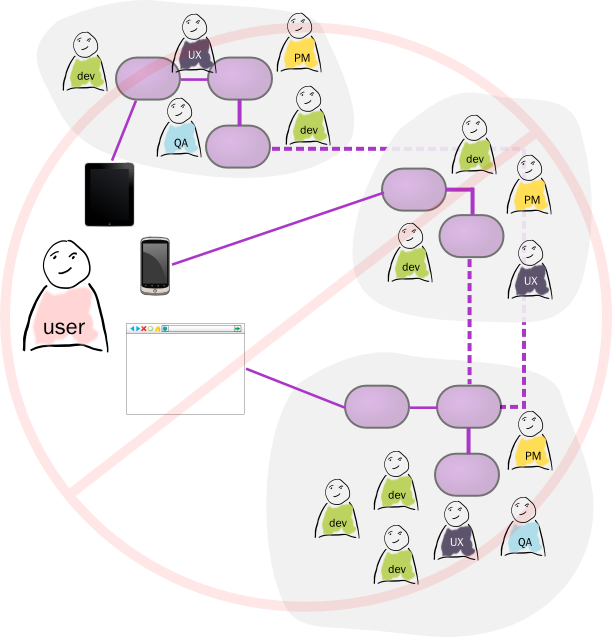
A common mistake is to think of different apps for different
delivery devices.
Instead think of a single app with different presentations on
different devices.
Imagine I'm using an app to find cool bars. There are many
contexts in which I could use such an application:
sitting in a coffee shop for breakfast, figuring out on my
tablet where I'm
going to meet my friends this evening.
editing my photos at my desk [1] I see a picture of a really good
bar I want to recommend to someone, so I access the application for
information that I then email off with the photo
it's five-thirty, I've had a long meeting, and I'm walking the
streets looking for a nearby bar on my phone.
I'm at home, with some friends, and we're exploring bar options
for later on my ginormous flat screen tv.
In these cases what I'm trying to do is interact with some
notional application, but I'm doing so through very different devices
in very different contexts. Despite this, however, I don't want to
see these as separate applications, but as different presentations
of a single application. Ideally I could swap between them even in
a single context (I don't know how to find bars near me on the
web site on my laptop, so it's quicker to do it the way I normally do on
the phone than look up the help docs.)
That's a consumer case, but the same thinking applies for
in-house applications. If I'm a retail store manager I may do some
stock checking by prowling the aisles with a tablet, but do other
stock management work at my desk where I have a bigger monitor and
keyboard.
As usual, what counts here is the user experience, it's about how
software helps the user achieve their desires better.The user just
wants that "I
Rule" moment. The fact that the company commissioning the
software wants to send out the web site and mobile app to different
software houses is less relevant than 1923's baseball scores. So the
user goes elsewhere and the app provider is a victim of the shattered
future.
It's as though the single screens of yesterday have been
shattered and the shards have been embedded into our pockets, our
environment, and the products we use.
Such transmedia thinking [2] goes beyond the common
phone/web/tablet devices. Back in 2005 when Tim O'Reilly launched
the Web 2.0 meme, one his patterns for the next generation of
software was Software
Above the Level of a Single Device. His exemplar for this was
the iPod, whose success was partly due to how "This application
seamlessly reaches from the handheld device to a massive web
back-end, with the PC acting as a local cache and control station"
The product wasn't just the iPod, it was the iPod plus iTunes
combination. Todays leading exemplar might be Netflix, which is a
product you habitually use in a transmedia manner - with many
different devices allowing you to see your movies on a TV, including
one of which involves the post office as a data transport medium.
This last point should remind us that transmedia thinking is in
many ways just basic systems analysis. When doing analysis work for
a software project, the point is to look at the overall domain
process and consider how software can best support it. The
transmedia label helps remind us that software can pop up in all
sorts of places where we might not consider it before.
An important of part envisioning a transmedia application is that
each device is used in different contexts to do different things. As
a result the experience needs to designed with these contexts in
mind - both in being aware of the different contexts and thinking
about how they flow together. If you're looking for bar on your
phone, you're much more likely to want to know nearby bars than if
you're going through the website on your desk. If you're interacting
with a travel management application, it should be able to tell that
you're accessing via a phone, you're in your connecting airport
between two flights, and thus make it easy for you to see how long
you have to get to your connecting flight and how to get to the
gate.
This is why I consider the desire to create a mobile application
to be a Wrong Thought. It immediately frames the mobile application
as something separate from the web site, as is the thinking that
you're building just a web site. Instead you need to start
with the user, figuring out what it is that they want to do and how
software can help them do that. When thinking about this everyone
needs to be thinking in a transmedia manner - and by everyone I
mean all parts of the work: user experience, software architecture,
project management…. The application, and the project team that
builds it, need to be thought of as a single whole, all dedicated to
making their users happy.
Further Reading
Kelly Sommers (kellabyte) provides
an example what a transmedia application might look like.
This article also explores the notion of transmedia storytelling with
some interesting links and videos.
Jonny LeRoy wrote a couple of articles on surviving the
shattered future, talking about the challenges in a world where
users want to use different media to interact.
1:
A lot of people I talk to these days think the desktop is fast
dying and that in time all our computer usage will be using
tablets or mobiles. But I like working at a desk. When we bought
our house I ensured we installed an ethernet jack on the porch
so I could do my email on a laptop (this was before wireless).
And for several years I'd use my laptop like this for a good
chunk of time. But eventually I found it too limiting to work
that way compared to the huge monitors on my desk. So while I
think there's an increasing role for tablets and other devices,
I still think the desktop will remain an important environment.
2:
The term "transmedia" comes from the concept of transmedia storytelling
which is all about telling a single story that
uses different media: film, comics, games etc. This is different
to using different representations of the same story, such
as novelizations, in that the different media are intended to be
woven into a single whole. This is why I think that "transmedia"
is a good term to appropriate for this kind of application. (My
thanks to Kyle Hodgson for introducing me to the transmedia
meme.)
3:
Although continuous client is clearly a very similar concept, I
do see a distinction in that I can imagine applications that are
designed and experienced as separate applications supporting
continuous client behavior by coordinating on how they do
hand-offs between each other. The result would be an effective
continuous client, but not a holistic transmedia application.


 Previous Topic