This post originated from an RSS feed registered with Agile Buzz
by Martin Fowler.
Original Post: Bliki: BranchByAbstraction
Feed Title: Martin Fowler's Bliki
Feed URL: http://martinfowler.com/feed.atom
Feed Description: A cross between a blog and wiki of my partly-formed ideas on software development
"Branch by Abstraction" is a technique [1]
for making a large-scale change to a software system in gradual way
that allows you to release the system regularly while the change is
still in-progress.
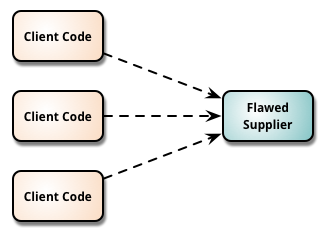
We begin with a situation where various parts of the software
system are dependent on a module, library, or framework that we
wish to replace
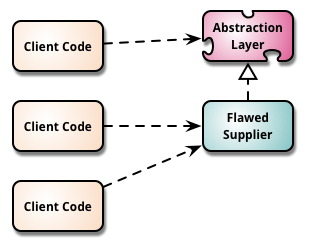
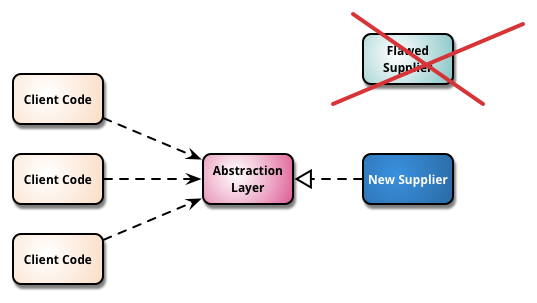
We create an abstraction layer that captures the interaction
between one section of the client code and the current supplier.
We change that section of the client code to call the supplier
entirely through this abstraction layer.
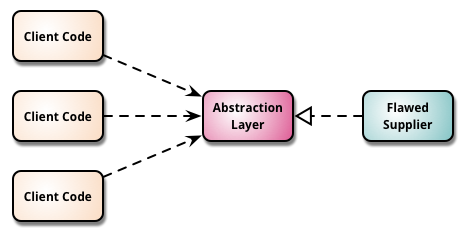
We gradually move all client code over to use the abstraction
layer until all interaction with the supplier is done by the
abstraction layer. As we do this we take the opportunity to
improve the unit test coverage of the supplier through this
abstraction layer.
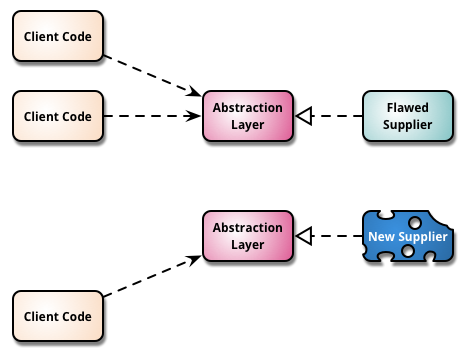
We build a new supplier that implements the features required by
one part of the client code using the same abstraction layer [2]. Once
we are ready we switch that section of the client code to use the
new supplier.
We gradually swap out the flawed supplier until all the client
code uses the new supplier. Once the flawed supplier isn't needed,
we can delete it. We may also choose to delete the abstraction
layer once we no longer need it for migration.
My description above describes a common case, but there are plenty
of variation that can occur. Sometimes you can't
swap-out the supplier for only some clients, you have to do it all at
once. Sometimes you can break down the features of the supplier into
different sub-components and carry out this whole procedure one
sub-component at a time.
Despite these variations, there is a common theme. Use an
abstraction layer to allow multiple implementations to co-exist in
the software system. Use the notion of one abstraction and multiple
implementations to perform the migration from one implementation to
the other. Ensure that the system builds and runs correctly at all
times, so you can continue to use Continuous Delivery while you are
doing the replacement. Look for as many ways as possible to make
changes gradually.
Further Reading
Jez
Humble describes how his team used Branch-by-Abstraction to
replace both an object-relational mapping framework (ibatis to
hibernate) and the web UI framework (velocity/JsTemplate to Ruby
on Rails) for ThoughtWorks's Continuous Delivery tool "Go".
Paul Hammant provides more
details of using Branch-by-Abstraction, particularly as an
alternative to using version-control branching.
Acknowledgements
Thanks to Paul Hammant for his detailed
suggestions as well as being an important primary source.
Notes
1:
This technique has been around for a long time, although it
never got a popular name. Paul Hammant introduced the term "Branch by
Abstraction" while arguing in favor of Trunk
Based Development (he credits Stacy Curl with originally
coming up with it). This name seems to have caught on and is now
the term I most commonly hear.
2:
While we are building the new feature we can use
FeatureToggles to run the new supplier in test
environments and compare its behavior to the flawed supplier.


 Previous Topic