This post originated from an RSS feed registered with Agile Buzz
by Martin Fowler.
Original Post: Bliki: DiversityMediocrityIllusion
Feed Title: Martin Fowler's Bliki
Feed URL: http://martinfowler.com/feed.atom
Feed Description: A cross between a blog and wiki of my partly-formed ideas on software development
I've often been involved in discussions about deliberately
increasing the diversity of a group of people. The most common case
in software is increasing the proportion of women. Two examples are
in hiring and conference speaker rosters where we discuss trying to
get the proportion of women to some level that's higher than usual.
A common argument against pushing for greater diversity is that it
will lower standards, raising the spectre of a diverse but mediocre
group.
To understand why this is an illusionary concern, I like to
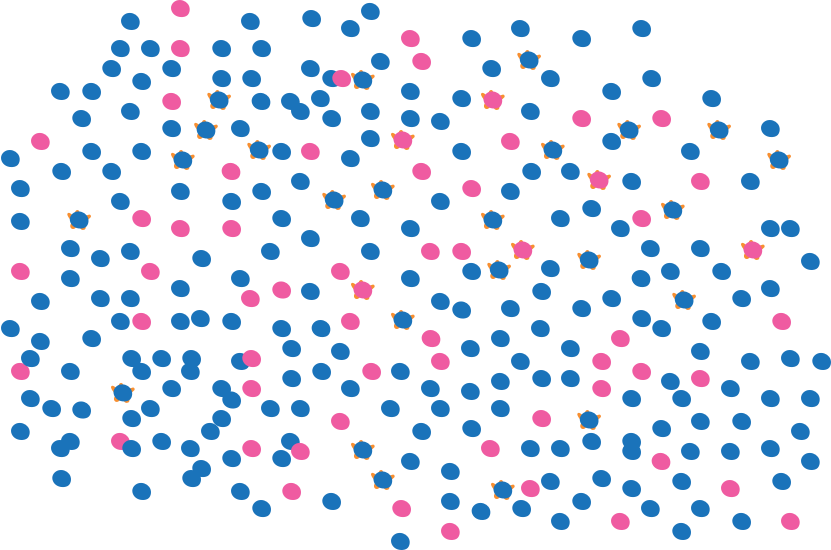
consider a little thought experiment. Imagine a giant bucket that
contains a hundred thousand marbles. You know that 10% of these
marbles have a special sparkle that you can see when you carefully
examine them. You also know that 80% of these marbles are blue and
20% pink, and that sparkles exist evenly across both colors [1]. If you were
asked to pick out ten sparkly marbles, you know you could
confidently go through some and pick them out. So now imagine you're
told to pick out ten marbles such that five were blue and five were
pink.
I don't think you would react by saying “that's impossible”.
After all there are two thousand pink sparkly marbles in there,
getting five of them is not beyond the wit of even a man. Similarly
in software, there may be less women in the software business, but
there are still enough good women to fit the roles a company or a
conference needs.
The point of the marbles analogy, however, is to focus on the
real consequence of the demand for 50:50 split. Yes it's possible to
find the appropriate marbles, but the downside is that it takes
longer. [2]
That notion applies to finding the right people too. Getting
a better than base proportion of women isn't impossible, but it does
require more work, often much more work. This extra effort
reinforces the rarity, if people have difficulty finding good
people as it is, it needs determined effort to spend the extra time
to get a higher proportion of the minority group — even if you are
only trying to raise the proportion of women up to 30%, rather than
a full 50%.
In recent years we've made increasing our diversity a high
priority at ThoughtWorks. This has led to a lot of effort trying to
go to where we are more likely to run into the talented women we are
seeking: women's colleges, women-in-IT groups and conferences. We
encourage our women to speak at conferences, which helps let other
women know we value a diverse workforce.
When interviewing, we make a point of ensuring there are women
involved. This gives women candidates someone to relate to, and
someone to ask questions which are often difficult to ask men. It's
also vital to have women interview men, since we've found that women
often spot problematic behaviors that men miss as we just don't have
the experiences of subtle discriminations. Getting a diverse group
of people inside the company isn't just a matter of recruiting, it
also means paying a lot of attention to the environment we have, to try to
ensure we don't have the same AlienatingAtmosphere that
much of the industry exhibits. [3]
One argument I've heard against this approach is that if everyone
did this, then we would run out of pink, sparkly marbles. We'll know
this is something to be worried about when women are paid
significantly more than men for the same work.
One anecdote that stuck in my memory was from a large,
traditional company who wanted to improve the number of women in
senior management positions. They didn't impose a quota on
appointing women to those positions, but they did impose a quota for
women on the list of candidates. (Something like: "there must be at
least three credible women candidates for each post".) This
candidate quota forced the company to actively seek out women
candidates. The interesting point was that just doing this, with no
mandate to actually appoint these women, correlated with an increased
proportion of women in those positions.
For conference planning it's a similar strategy: just putting out a call for
papers and saying you'd like a diverse speaker lineup isn't enough.
Neither are such things as blind review of proposals (and I'm not
sure that's a good idea anyway). The important thing is to seek out
women and encourage them to submit ideas. Organizing conferences is
hard enough work as it is, so I can sympathize with those that don't
want to add to the workload, but those that do can get there. FlowCon
is a good example of a conference that made this an explicit
goal and did far better than the industry average (and in case you
were wondering, there was no
difference between men's and women's evaluation scores).
So now that we recognize that getting greater diversity is a
matter of application and effort, we can ask ourselves whether the
benefit is worth the cost. In a broad professional sense, I've
argued that it is, because our DiversityImbalance is
reducing our ability bring the talent we need into our profession,
and reducing the influence our profession needs to have on society.
In addition I believe there is a moral argument to push back against
long-standing wrongs faced by
HistoricallyDiscriminatedAgainst groups.
Conferences have an important role to play in correcting this
imbalance. The roster of speakers is, at least subconsciously, a
statement of what the profession should look like. If it's all white
guys like me, then that adds to the AlienatingAtmosphere
that pushes women out of the profession. Therefore I believe that
conferences need to strive to get an increased proportion of
historically-discriminated-against speakers. We, as a profession,
need to push them to do this. It also means that women have an
extra burden to become visible and act as part of that better
direction for us. [4]
For companies, the choice is more personal. For me,
ThoughtWorks's efforts to improve its diversity are a major factor
in why I've been an employee here for over a decade. I don't think
it's a coincidence that ThoughtWorks is also a company that has a
greater open-mindedness, and a lack of political maneuvering, than most of the
companies I've consulted with over the years. I consider those
attributes to be a considerable competitive advantage in attracting
talented people, and providing an environment where we can
collaborate effectively to do our work.
But I'm not holding ThoughtWorks up as an example of perfection.
We've made a lot of progress over the decade I've been here, but we
still have a long way to go. In particular we are very short of
senior technical women. We've introduced a number of programs around
networks, and leadership development, to help grow women
to fill those gaps. But these things take time - all you have to do
is look at our Technical Advisory Board
to see that we are a long way from the ratio we seek.
Despite my knowledge of how far we still have to climb, I can
glimpse the summit ahead. At a recent AwayDay in Atlanta I was
delighted to see how many younger technical women we've managed to
bring into the company. While struggling to keep my head above water
as the sole male during a late night game of Dominion, I enjoyed a
great feeling of hope for our future.
Notes
1:
That is 10% of blue marbles are sparkly as are 10% of pink.
2:
Actually, if I dig around for a while in that bucket, I find
that some marbles are neither blue nor pink, but some
engaging mixture of the two.
3:
This is especially tricky for a company like us, where so much
of our work is done in client environments, where we aren't able
to exert as much of an influence as we'd like. Some of our
offices have put together special training to educate both sexes
on how to deal with sexist situations with clients. As a man, I
feel it's important for me to know how I can be supportive, it's
not something I do well, but it is something I want to learn to improve.
4:
Many people find the pressure of public speaking intimidating
(I've come to hate it, even with all my practice). Feeling that
you're representing your entire gender or race only makes it
worse.
Acknowledgements
Camila Tartari, Carol Cintra, Dani Schufeldt, Derek Hammer, Isabella
Degen, Korny Sietsma, Lindy Stephens, Mridula Jayaraman, Nikki
Appleby, Rebecca Parsons, Sarah Taraporewalla, Stefanie Tinder, and Suzi
Edwards-Alexander
commented on
drafts of this article.


 Previous Topic