This post originated from an RSS feed registered with Agile Buzz
by Martin Fowler.
Original Post: Bliki: Yagni
Feed Title: Martin Fowler's Bliki
Feed URL: http://martinfowler.com/feed.atom
Feed Description: A cross between a blog and wiki of my partly-formed ideas on software development
Yagni originally is an acronym that stands for "You Aren't Gonna
Need It". It is a mantra from ExtremeProgramming
that's often used generally in agile software teams. It's a
statement that some capability we presume our software needs in the future
should not be built now because "you aren't gonna need it".
Yagni is a way to refer to the XP practice of Simple Design (from
the first edition of The White Book, the second edition refers to
the related notion of "incremental design"). [1] Like many elements of XP, it's a sharp contrast to
elements of the widely held principles of software engineering in
the late 90s. At that time there was a big push for careful up-front
planning of software development.
Let's imagine I'm working with a startup in Minas Tirith selling
insurance for the shipping business. Their software system is broken
into two main components: one for pricing, and one for sales. The
dependencies are such that they can't usefully build
sales software until the relevant pricing software is completed.
At the moment, the team is working on updating the pricing
component to add support for risks from storms. They know that in six
months time, they will need to also support pricing for piracy
risks. Since they are currently working on the pricing engine they consider
building the presumptive feature [2] for piracy pricing now, since that way the pricing
service will be complete before they start working on the sales
software.
Yagni argues against this, it says that since you won't need
piracy pricing for six months you shouldn't build it until it's
necessary. So if you think it will take a two months to build this
software, then you shouldn't start for another four months
(neglecting any buffer time for schedule risk and updating the sales
component).
The first argument for yagni is that while we may now think we
need this presumptive feature, it's likely that we will be wrong.
After all the context of agile methods is an acceptance that we
welcome changing requirements. A plan-driven requirements guru might
counter argue that this is because we didn't do a good-enough job of
our requirements analysis, we should have put more time and effort
into it. I counter that by pointing out how difficult and costly it is to
figure out your needs in advance, but even if you can, you can still
be blind-sided when the Gondor Navy wipes out the pirates, thus
undermining the entire business model.
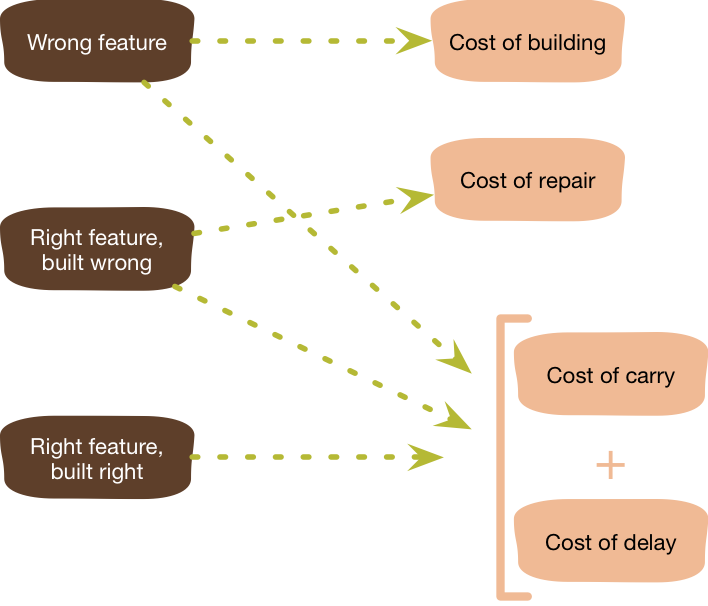
In this case, there's an obvious cost of the presumptive feature
- the cost of build: all the effort spent on analyzing, programming,
and testing this now useless feature.
But let's consider that we were completely correct with our
understanding of our needs, and the Gondor Navy didn't wipe out the
pirates. Even in this happy case, building the
presumptive feature incurs two
serious costs. The first cost is the cost of delayed value. By
expending our effort on the piracy pricing software we didn't build
some other feature. If we'd instead put our energy into building
the sales software for weather risks, we could have put a full
storm risks feature into production and be generating revenue two
months earlier. This cost of delay due to the presumptive feature is
two months revenue from storm insurance.
The common reason why people build presumptive features is
because they think it will be cheaper to build it now rather than
build it later. But that cost comparison has to be made at least
against the cost of delay, preferably factoring in the
probability that you're building an unnecessary feature, for which
your odds are at least ⅔. [3]
Often people don't think through the comparative cost of building
now to building later. One approach I use when mentoring developers
in this situation is to ask them to imagine any refactoring they
would have to do later to introduce the capability when it's needed.
Often that thought experiment is enough to convince them that it
won't be significantly more expensive to add it later. Another
result from such an imagining is to add something that's easy to do
now, adds minimal complexity, yet significantly reduces the later
cost. Using lookup tables for error messages rather than inline
literals are an example that are simple yet
make later translations easier to support.
Reminder, any extensibility point that’s never used isn’t just
wasted effort, it’s likely to also get in your way as well
-- Jeremy Miller
The cost of delay is one cost that a successful presumptive
feature imposes, but another is the cost of carry. The code for the
presumptive feature adds some complexity to the software, this
complexity makes it harder to modify and debug that software, thus
increasing the cost of other features. The extra complexity from
having the piracy-pricing feature in the software might add a couple
of weeks to how long it takes to build the storm insurance sales
component. That two weeks hits two ways: the additional cost to
build the feature, plus the additional cost of delay since it look
longer to put it into production. We'll incur a cost of carry on every
feature built between now and the time the piracy insurance software
starts being useful. Should we never need the piracy-pricing
software, we'll incur a cost of carry on every feature built until
we remove the piracy-pricing feature (assuming we do), together with
the cost of removing it.
So far I've divided presumptive features in two categories:
successful and unsuccessful. Naturally there's really a spectrum
there, and with one point on that spectrum that's worth highlighting: the right
feature built wrong. Development teams are always learning, both
about their users and about their code base. They learn about the
tools they're using and these tools go through regular upgrades. They
also learn about how their code works together. All this means that
you often realize that a feature coded six months ago wasn't done
the way you now realize it should be done. In that case you have
accumulated TechnicalDebt and have to
consider the cost of repair for that feature or the on-going
costs of working around its difficulties.
So we end up with three classes of presumptive features, and four
kinds of costs that occur when you neglect yagni for them.
Yagni is at its most visible with larger features, but you see it
more frequently with small things. Recently I wrote some code that
allows me to highlight part of a line of code. For this, I allow the
highlighted code to be specified using a regular expression. One
problem I see with this is that since the whole regular expression
is highlighted, I'm unable to deal with the case where I need the
regex to match a larger section than what I'd like to highlight. I
expect I can solve that by using a group within the regex and
letting my code only highlight the group if a group is present. But I
haven't needed to use a regex that matches more than what I'm
highlighting yet, so I haven't extended my highlighting code to
handle this case - and won't until I actually need it. For similar
reasons I don't add fields or methods until I'm actually ready to
use them.
Small yagni decisions like this fly under the radar of project
planning. As a developer it's easy to spend an hour adding a feature
that we're sure will soon be needed. Yet all the arguments above
still apply, and a lot of small yagni decision adds up to
significant reductions in complexity to a code base while speeding
up delivery of features that are needed more urgently.
Now we understand why yagni is important we can dig into a common
confusion about yagni. Yagni only applies to capabilities built
into the software to support a presumptive feature, it does not
apply to effort to make the software easier to modify. Yagni is
only a viable strategy if the code is easy to modify, so expending
effort on refactoring isn't a violation of yagni because refactoring
makes the code more malleable. Similar reasoning applies for
practices like SelfTestingCode and
ContinuousDelivery. These are enabling practices for evolutionary
design, without them yagni turns from a beneficial practice into
a curse. But if you do have a malleable code base, then yagni
reinforces that flexibility. Yagni has the curious property that it
is both enabled by and enables evolutionary design.
Yagni is not a justification for neglecting the health of your
code base. Yagni requires (and enables) malleable code.
I also argue that yagni only applies when you introduce extra
complexity now that you won't take advantage of until later. If you
do something for a future need that doesn't actually increase the
complexity of the software, then there's no reason to invoke yagni.
Having said all this, there are times when applying yagni does cause
a problem, and you are faced with an expensive change when an
earlier change would have been much cheaper. The tricky thing here
is that these cases are hard to spot in advance, and much easier to
remember than the cases where yagni saved effort [4]. My sense is that yagni-failures are relatively
rare and their costs are easily outweighed by when yagni
succeeds.
Further Reading
My essay Is Design
Dead talks in more detail about the role of design and
architecture in agile projects, and thus role yagni plays as an
enabling practice.
This principle was first discussed and fleshed out on Ward's Wiki.
Notes
1:
The origin of the phrase is an early conversation between Kent
Beck and Chet Hendrickson on the C3 project. Chet
came up to Kent with a series of capabilities that the system
would soon need, to each one Kent replied "you aren't
going to need it". Chet's a fast learner, and quickly became
renowned for his ability to spot opportunities to apply yagni.
Although "yagni" began life as an acronym, I feel it's now
entered our lexicon as a regular word, and thus forego the
capital letters.
2:
In this post I use "presumptive feature" to refer to any code
that supports a feature that isn't yet being made available for
use.
3:
The ⅔ number is suggested by Kohavi
et al, who analyzed the value of features built and deployed
on products at microsoft and found that, even with careful
up-front analysis, only ⅓ of them improved the metrics they were
designed to improve.
4:
This is a consequence of availability bias
Acknowledgements
Rachel Laycock talked through this post with me and played a
critical role in its final organization. Chet Hendrickson and
Steven Lowe reminded
me to discuss small-scale yagni decisions.
Rebecca Parsons, Alvaro Cavalcanti, Mark Taylor, Aman King, Rouan
Wilsenach, Peter Gillard-Moss, Kief Morris, Ian Cartwright, James
Lewis, Kornelis Sietsma, and Brian Mason participated in an insightful
discussion about drafts of this article on our internal mailing list.


 Previous Topic


 , the second edition refers to
the related notion of "incremental design").
, the second edition refers to
the related notion of "incremental design").