This post originated from an RSS feed registered with Agile Buzz
by Martin Fowler.
Original Post: Bliki: AliasingBug
Feed Title: Martin Fowler's Bliki
Feed URL: http://martinfowler.com/feed.atom
Feed Description: A cross between a blog and wiki of my partly-formed ideas on software development
Aliasing occurs when the same memory location is accessed through more than one
reference. Often this is a good thing, but frequently it occurs in an unexpected way,
which leads to confusing bugs.
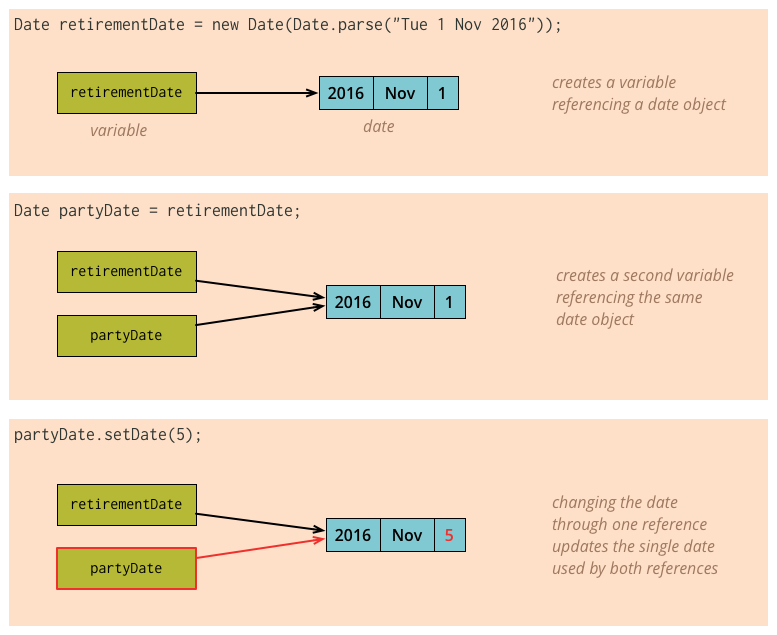
Here's a simple example of the bug.
Date retirementDate = new Date(Date.parse("Tue 1 Nov 2016"));

// this means we need a retirement party
Date partyDate = retirementDate;

// but that date is a Tuesday, let's party on the weekend
partyDate.setDate(5);

assertEquals(new Date(Date.parse("Sat 5 Nov 2016")), retirementDate);
// oops, now I have to work three more days :-(
What's happening here is that when we do the assignment, the partyDate variable is
assigned a reference to the same object that the retirement data refers to. If I then
alter the internals of that object (with setDate) then both variables are
updated, since they refer to the same thing.
Although aliasing is a problem in that example, in other contexts it's what I expect.
Person me = new Person("Martin");
me.setPhoneNumber("1234");
Person articleAuthor = me;
me.setPhoneNumber("999");
assertEquals("999", articleAuthor.getPhoneNumber());
It's common to want to share records like this, and then if it changes, it changes
for all references. This is why it's useful to think of reference objects, which
we deliberately share [1], and Value Objects that we don't want this kind of shared update behavior. A good way to
avoid shared updates of value objects is to make value objects immutable.
Functional languages, of course, prefer everything to be immutable. So if we want
changes to be shared, we need to handle that as the exception rather than the rule.
Immutability is a handy property, one that makes it harder to create several kinds of
bugs. But when things do need to change, immutability can introduce complexity, so it's
by no means a free breakfast.
Acknowledgements
Graham Brooks and James Birnie's comments on our internal mailing list led me to
write this post.
Further Reading
The term aliasing bug has been around for a while. It appears in Eric Raymond's
Jargon
file in the context of the C language where the raw memory accesses make it even more
unpleasant.
Notes
1:
The Evans Classification has the notion of Entity, which I see as a common form of
reference object.
Share:
if you found this article useful, please share it. I appreciate the feedback and encouragement


 Previous Topic