This post originated from an RSS feed registered with Agile Buzz
by Martin Fowler.
Original Post: Bliki: FunctionLength
Feed Title: Martin Fowler's Bliki
Feed URL: http://martinfowler.com/feed.atom
Feed Description: A cross between a blog and wiki of my partly-formed ideas on software development
During my career, I've heard many arguments about how long a function should be. This
is a proxy for the more important question - when should we enclose code in its own
function? Some of these guidelines were based on length, such as functions should be no
larger than fit on a screen [1]. Some were based on reuse - any
code used more than once should be put in its own function, but code only used once
should be left inline. The argument that makes most sense to me, however, is the
separation between intention and implementation. If you have to spend effort into
looking at a fragment of code to figure out what it's doing, then you should
extract it into a function and name the function after that “what”. That way when you
read it again, the purpose of the function leaps right out at you, and most of the time
you won't need to care about how the function fulfills its purpose - which is the body
of the function.
Once I accepted this principle, I developed a habit of writing very small functions -
typically only a few lines long. Any function more than half-a-dozen lines of code
starts to smell to me, and it's not unusual for me to have functions that are a single
line of code [2]. The fact that size isn't important was brought
home to me by an example that Kent Beck showed me from the original Smalltalk system.
Smalltalk in those days ran on black-and-white systems. If you wanted to highlight some
text or graphics, you would reverse the video. Smalltalk's graphics class had a method
for this called 'highlight', whose implementation was just a call to the method
'reverse' [3]. The name of the method was longer than its
implementation - but that didn't matter because there was a big distance between the
intention of the code and its implementation.
Some people are concerned about short functions because they are worried about the
performance cost of a function call. When I was young, that was occasionally a factor,
but that's very rare now. Optimizing compilers often work better with shorter functions
which can be cached more easily. As ever, the general guidelines on performance
optimization are what counts. Sometimes inlining the function later is what you'll
need to do, but often smaller functions suggest other ways to speed things up. I remember
people objecting to having an isEmpty method for a list when the
common idiom is to use aList.length == 0. But here using the
intention-revealing name on a function may also support better performance if it's
faster to figure out if a collection is empty than to determine its length.
Small functions like this only work if the names are good, so you need to pay good
attention to naming. This takes practice, but once you get good at it, this approach can
make code remarkably self-documenting. Larger scale functions can read like a story, and
the reader can choose which functions to dive into for more detail as she needs it.
Acknowledgements
Brandon Byars, Karthik Krishnan, Kevin Yeung, Luciano Ramalho, Pat Kua, Rebecca Parsons, Serge
Gebhardt, Srikanth Venugopalan, and Steven Lowe
discussed drafts of this post on our internal mailing list.
Notes
1:
Or in my first programming job: two pages of line printer paper - around 130 lines
of Fortran IV
2: Length of my functions
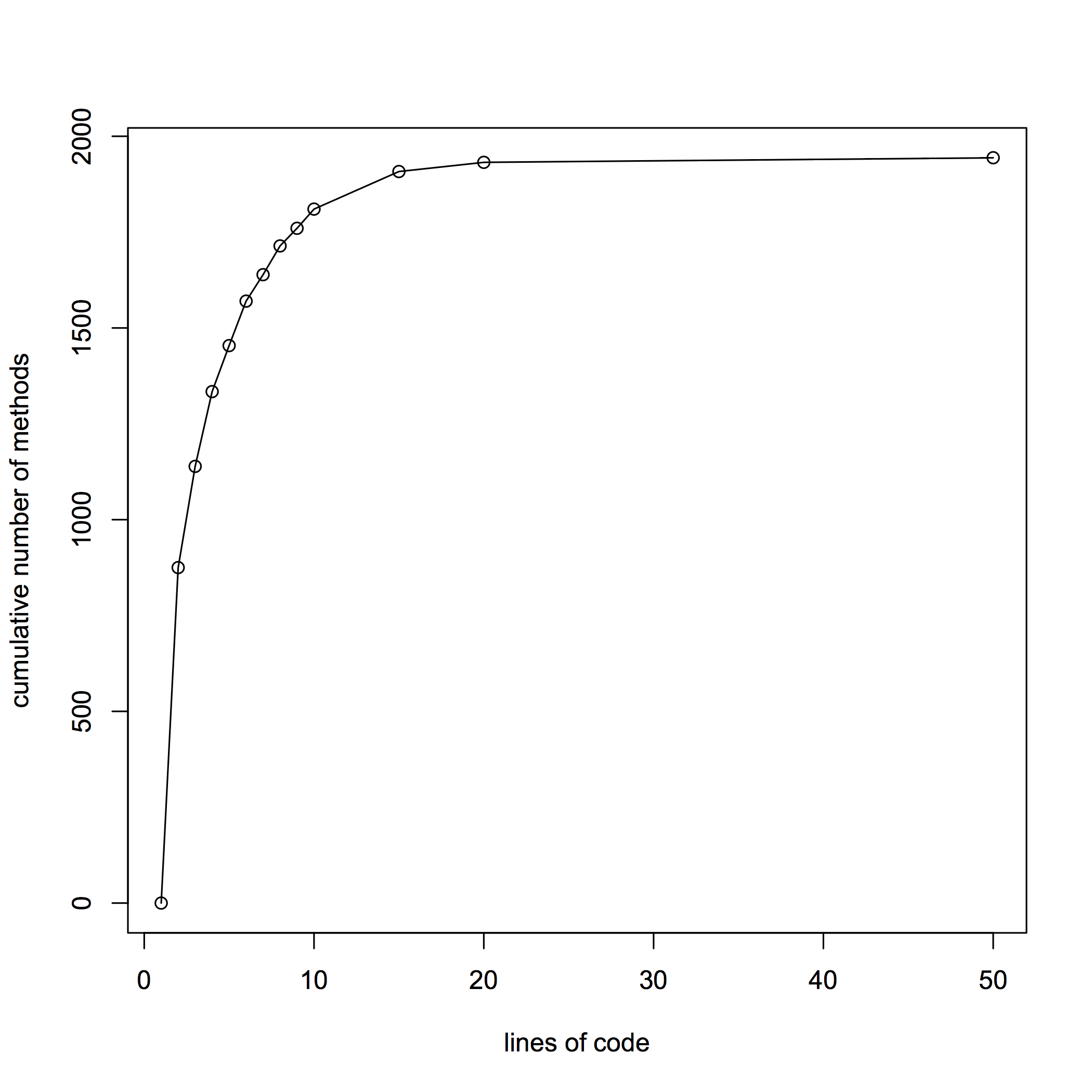
Recently I got curious about function length in the toolchain that builds this
website. It's mostly Ruby and runs to about 15 KLOC. Here's a cumulative frequency
plot for the method body lengths
As you see there's lots of small methods there - half of the methods in my
codebase are two lines or less. (lines here are non-comment, non-blank, and
excluding the def and end lines.)
Here's the data in a crude tabular form (I'm feeling too lazy to turn it into
proper HTML tables).


 Previous Topic


 in Intention Revealing Message


