
How to Maximize Cohesion While Avoiding Explosion
First published in JavaWorld, April 1998
In last month's Design Techniques column, I told half of the method design story: minimizing method coupling. In this month's installment, I'll reveal the other half of the story: maximizing method cohesion.
As with last month's column, "Designing fields and methods," the principles discussed may be familiar to many readers, as they apply to just about any programming language. But given the vast quantity of code I have encountered in my career that didn't benefit from these basic principles, I feel it is an important public service to address the basics in the early installments of this column. In addition, I have attempted in this article to show how the basic principles apply in particular to the Java programming language.
Cohesion
Methods do things. On a low level, they do things such as accept data as input, operate on that data, and deliver data as output. On a higher level, they do things such as "clone this object," "print this string to the standard output," "add this element to the end of this vector," and "add this much coffee to this cup object."
Minimizing coupling (the topic of last month's article) requires you to look at methods on a low level. Coupling looks at how the inputs and outputs of a method connect it to other parts of the program. By contrast, maximizing cohesion requires that you look at methods on a high level. Cohesion looks at the degree to which a method accomplishes one conceptual task. The more a method is focused on accomplishing a single conceptual task, the more cohesive that method is.
Why maximize cohesion?
The more cohesive you make your methods, the more flexible (easy to understand and change) your code will be. Cohesive methods help make your code more flexible in two ways:
- If your method is focused on a single conceptual task, you can more easily choose a method name that clearly indicates what your method does. For example, a method named
int convertOzToMl(int ounces), which converts ounces to milliliters, is easier to comprehend at first glance than a method namedint convert(int fromUnits, int toUnits, int fromAmount). At first glance, you could guess that theconvert()method may be able to convert ounces to milliliters, but even if that were so, you would need to do more digging to find out whatfromUnitsvalue represents ounces and whattoUnitsvalue represents milliliters. TheconvertOzToMl()method is more cohesive than theconvert()method because it does just one thing, and its name indicates what that thing is. - Cohesive methods help make your code more flexible because changes are easier to make when you can draw upon a set of methods, each of which performs a single conceptual task. Cohesive methods increase the odds that when you need to change a class's behavior at some point in the future, you'll be able to do so by writing code that invokes existing methods in a new way. In addition, changes to an existing behavior are more isolated if that behavior is encased in its own method. If several behaviors are intermixed in a single (non-cohesive) method, changes to one behavior may inadvertently add bugs to other behaviors that share that same method.
Low cohesion
As an example of a method that is not very functionally cohesive, consider this alternate way of designing a class that models coffee cups:
// In Source Packet in file:
//      cohesion/ex1/CoffeeCup.java
// THIS APPROACH WORKS, BUT MAKES THE CODE
// HARD TO UNDERSTAND AND HARD TO CHANGE
public class CoffeeCup {

    public final static int ADD = 0;
    public final static int RELEASE_SIP = 1;
    public final static int SPILL = 2;

    private int innerCoffee;

    public int modify(int action, int amount) {

        int returnValue = 0;

        switch (action) {
        case ADD:
            // add amount of coffee
            innerCoffee += amount;

            // return zero, even though that is meaningless
            break;

        case RELEASE_SIP:
            // remove the amount of coffee passed as amount
            int sip = amount;
            if (innerCoffee < amount) {
                sip = innerCoffee;
            }
            innerCoffee -= sip;

            // return removed amount
            returnValue = sip;
            break;

        case SPILL:
            // set innerCoffee to 0
            // ignore parameter amount
            int all = innerCoffee;
            innerCoffee = 0;

            // return all coffee
            returnValue = all;

        default:
            // Here should throw an exception, because they
            // passed an invalid command down in action
            break;
        }

        return returnValue;
    }
}
CoffeeCup's modify() method is not very cohesive because it includes code to do tasks that, conceptually, are quite different. Yes, it is a useful method. It can add, sip, and spill, but it can also perplex, befuddle, and confuse. This method is difficult to understand partly because its name, modify(), isn't very specific. If you tried to make the name more specific, however, you would end up with something like addOrSipOrSpill(), which isn't much clearer.
Another reason modify() is hard to understand is that some of the data passed to it or returned from it is used only in certain cases. For example, if the action parameter is equal to CoffeeCup.ADD, the value returned by the method is meaningless. If action equals CoffeeCup.SPILL, the amount input parameter is not used by the method. If you look only at the method's signature and return type, it is not obvious how to use the method.
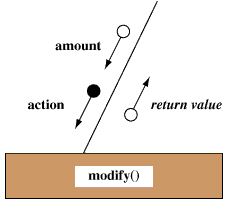 Figure 1: Passing control down to modify(). |
See Figure 1 for a graphical depiction of this kind of method. In this figure, the circle for the action parameter is solid black. The blackened circle indicates that the parameter contains data that is used for control. You can differentiate data that is used for control from data that isn't by looking at how a method uses each piece of input data. Methods process input data and generate output data. When a method uses a piece of input data not for processing, but for deciding how to process, that input data is used for control.
To maximize cohesion, you should avoid passing control down into methods. Instead, try to divide the method's functionality among multiple methods that don't require passing down control. In the process, you'll likely end up with methods that have a higher degree of cohesion.
By the way, it is fine to pass data used for control back up from a method. (Throwing an exception is a good example of passing control up.) In general, up is the direction control should go: Data used for control should be passed from a method back to the method that invoked it.
Medium cohesion
To increase the method cohesion of the previous CoffeeCup class, you could divide the functionality performed by modify() into two methods, add() and remove():
// In Source Packet in file cohesion/ex2/CoffeeCup.java
// THIS APPROACH WORKS, BUT MAKES THE CODE HARD TO UNDERSTAND
// AND HARD TO CHANGE
public class CoffeeCup {

    private int innerCoffee;

    public void add(int amount) {
        innerCoffee += amount;
    }

    public int remove(boolean all, int amount) {

        int returnValue = 0;

        if (all) {
            // set innerCoffee to 0
            // ignore parameter amount
            int allCoffee = innerCoffee;
            innerCoffee = 0;
            returnValue = allCoffee; // return all coffee
        }
        else {
            // remove the amount of coffee passed as amount
            int sip = amount;
            if (innerCoffee < amount) {
                sip = innerCoffee;
            }
            innerCoffee -= sip;
            returnValue = sip; // return removed amount
        }
       return returnValue;
    }
}
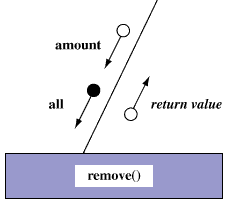 Figure 2: Passing control down to remove(). |
This is a better design, but it's not quite there yet. Although the add() method does not require you to pass down control, the remove() method still does. The boolean parameter all indicates to the remove method whether or not to remove all coffee (a spill) or to remove some coffee (a sip). In the case of a sip, the amount parameter indicates the amount of coffee to remove (the size of the sip). The graphical depiction of the remove() method, shown in Figure 2, shows a blackened circle heading down for the all parameter just as modify() had a blackened circle heading down for the action parameter. It also includes a parameter, amount, that is not always used, just as modify() is not always used. For remove(), if all is false, amount indicates the amount of coffee to remove. If all is true, amount is ignored.
High cohesion
A better design for the CoffeeCup class is to divide remove() into two more methods, neither of which accept control data as input or have parameters that are used only part of the time. Here remove() has been divided into releaseOneSip() and spillEntireContents():
// In Source Packet in file cohesion/ex3/CoffeeCup.java
class CoffeeCup {

    private int innerCoffee;

    public void add(int amount) {
        innerCoffee += amount;
    }

    public int releaseOneSip(int sipSize) {
        int sip = sipSize;
        if (innerCoffee < sipSize) {
            sip = innerCoffee;
        }
        innerCoffee -= sip;
        return sip;
    }

    public int spillEntireContents() {
        int all = innerCoffee;
        innerCoffee = 0;
        return all;
    }
}
As you can see, the process of removing input data used for control yields more methods, each with a more focused functionality. Instead of indicating your wishes to one comprehensive method by passing down a command as a parameter, you call a different method. For example, instead of saying:
// In Source Packet in file cohesion/ex1/Example1.java
class Example1 {

    public static void main(String[] args) {

        CoffeeCup cup = new CoffeeCup();
        // ignore bogus return value of modify() in ADD case
        cup.modify(CoffeeCup.ADD, 355);
        int mlCoffee = cup.modify(CoffeeCup.RELEASE_SIP, 25);
        // 2nd parameter is unused in SPILL case
        mlCoffee += cup.modify(CoffeeCup.SPILL, 0);

        System.out.println("Ml of coffee: " + mlCoffee);
    }
}
You say:
// In Source Packet in file cohesion/ex3/Example3.java
class Example3 {

    public static void main(String[] args) {

        CoffeeCup cup = new CoffeeCup();
        cup.add(355);
        int mlCoffee = cup.releaseOneSip(25);
        mlCoffee += cup.spillEntireContents();

        System.out.println("Ml of coffee: " + mlCoffee);
    }
}
As described earlier, this approach to method design yields code that is easier to understand because each method is responsible for performing one conceptual function, and the method's name can describe that one function. Such code is also easier to understand because the data passed in and out are always used and valid. In this example, add(int), int releaseOneSip(int), and spillEntireContents() are easier to understand at first glance than the int modify(int, int) from the low cohesion example.
In addition, this approach to method design yields code that is more flexible, because it is easier to change one functionality without affecting the others. For example, if you wanted to make some adjustments to the spilling behavior of the coffee cup class with modify(), you would have to edit the body of modify(). Because the code for spilling is intermingled in modify() with the code for sipping and adding, you might inadvertently introduce a bug in the adding behavior when you enhance the spilling behavior. In the CoffeeCup class with separate methods for adding, spilling, and sipping, your chances are better that you can enhance the spilling behavior without disturbing the adding and sipping behaviors.
Reducing assumptions
Functionally cohesive methods also increase code flexibility because they make fewer assumptions about the order in which particular actions are performed. Here is an example of a method that is not very functionally cohesive because it assumes too much:
// In Source Packet in file cohesion/ex4/CoffeeCup.java
class CoffeeCup {

    private int innerCoffee;
    private int innerCream;
    private int innerSugar;

    private static final int CREAM_FRACTION = 30;
    private static final int SUGAR_FRACTION = 30;

    public void add(int amountOfCoffee) {

        innerCoffee += amountOfCoffee;
        innerCream += amountOfCoffee/CREAM_FRACTION;
        innerSugar += amountOfCoffee/SUGAR_FRACTION;
    }
    //...
}
This CoffeeCup object keeps track not only of the amount of coffee it contains (innerCoffee), but also of the amount of cream (innerCream) and sugar (innerSugar). As you would expect, the add() method accepts an amount of coffee to add, then increments innerCoffee by that amount; however, add() doesn't stop there. It assumes that anyone wishing to add coffee to a cup also would want to add some cream and sugar, in fixed amounts relative to the amount of coffee added. So add() goes ahead and adds the cream and sugar as well.
The design of this method reduces code flexibility because later, if a programmer wanted to add coffee with cream, but no sugar, this method would be of no use. A more flexible design would be:
// In Source Packet in file cohesion/ex5/CoffeeCup.java
class CoffeeCup {

    private int innerCoffee;
    private int innerCream;
    private int innerSugar;

    public void addCoffee(int amount) {
        innerCoffee += amount;
    }

    public void addCream(int amount) {
        innerCream += amount;
    }

    public void addSugar(int amount) {
        innerSugar += amount;
    }
    //...
}
These methods are more functionally cohesive because they each do one thing. This design is more flexible because the programmer can call any of the methods at any time and in any order.
Cohesion is high-level
Although all of the examples of functionally cohesive methods so far have accepted, processed, and returned a very small amount of data, this is not a characteristic shared by all functionally cohesive methods. Cohesion means doing "one thing" on a high level, as in performing one conceptual activity -- not at a low level, as in processing one piece of data. For example, perhaps your virtual café has a regular customer, Joe, who always wants his coffee prepared with 30 parts coffee, 1 part cream, and 1 part sugar. If so, you could create a method such as:
// In Source Packet in file cohesion/ex5/VirtualCafe.java
class VirtualCafe {

    private static final int JOES_CREAM_FRACTION = 30;
    private static final int JOES_SUGAR_FRACTION = 30;

    public static void prepareCupForJoe(CoffeeCup cup, int amount) {

        cup.addCoffee(amount);
        cup.addCream(amount/JOES_CREAM_FRACTION);
        cup.addSugar(amount/JOES_SUGAR_FRACTION);
    }
}
The prepareCupForJoe() method is functionally cohesive even though, on a low level, it performs exactly the same function as the add() method, shown earlier, that wasn't functionally cohesive. The reason is that, conceptually, this method is preparing a cup of coffee for Joe, just the way he always likes it. The add() method, on the other hand, was adding coffee to a cup, and incidentally, also adding cream and sugar. Although add(), a member of class CoffeeCup, did not allow coffee to be added to a cup without also adding cream and sugar, prepareCupForJoe() involves no such restriction. Because prepareCupForJoe(), a member of class VirtualCafe, invokes addCoffee(), addCream(), and addSugar() from class CoffeeCup, it in no way prevents other methods from filling a cup with only coffee and cream, or any other combination in any proportion.
Method explosion
Although these guidelines can help you create code that is more flexible, following the guidelines too strictly can lead your code down the wrong alley. Factoring methods, such as modify(), into more cohesive methods, such as add(), releaseOneSip(), and spillEntireContents() leads to more methods. At some point your class will get difficult to use simply because it has too many methods.
As with all guidelines, you must use this one wisely and selectively. In general, you should maximize the cohesion of your methods. In general, you should avoid passing control down into a method. But there are some circumstances in which you should violate both of these principles.
For example, you may have a class that must respond differently to each of 26 different keypresses, one for each letter of the alphabet. Passing down the key to a method named void handleKeypress(char key) could reasonably be called passing down control, especially if the first thing you do is a switch(key), then have a case statement for each letter of the alphabet. But in this case, a single handleKeypress(char key) likely is easier to use and just as easy to understand as 26 separate methods handleAKeypress(), handleBKeypress(), handleCKeypress(), and so on.
Thus, you need to strike a balance between maximizing method cohesion and keeping the number of methods in a class to a reasonable level. There's no hard and fast rule to help you do this -- you just have to use your own judgment. After all, that's why they pay you the big bucks.
Cohesion in coding and writing
When you write software in a commercial environment, you aren't just writing down instructions for a machine, you are communicating your intentions to other human beings -- fellow programmers who may someday need to read your code to understand how to use or modify it. In a sense, when you code, you are writing, and many of the principles of good writing can be applied to good coding.
For example, a well-named, cohesive method in a Java program is analogous to a well-written paragraph in expository writing. A paragraph should have a main idea, usually stated in a topic sentence. Just as the topic sentence indicates to a prose reader the main idea of a paragraph, a descriptive method name tells a code reader what service that method performs. In a paragraph, every sentence should directly support the main idea. A paragraph, like a cohesive method, should be about one thing (indicated by the topic sentence), and all the sentences in the paragraph should be focused on that one thing.
A paragraph that doesn't stick to its topic, like a method that isn't cohesive, is harder to understand than a paragraph that focuses exclusively on its topic. Coupling, the topic of my previous article, doesn't really have an analog in the writing domain, but as I said previously in this article, a cohesive method maps to a well-written paragraph. Another metaphor for cohesion is glue. There are many kinds of glue, some of which emanate a stronger smell than others, which may give you a headache in certain cases. One of my favorite glues was the kind of paste we used in kindergarten. The lid had a brush attached to it, and we would -- oops, I just spilled some mocha on my printout -- cut out different colors of construction paper and glue them together. Those were the days...
See what I mean? What do coupling, glue, headaches, kindergarten, mochas, and construction paper have to do with the difficulty in understanding a non-cohesive paragraph? Not much. In fact, these sentences comprise an example of a paragraph that doesn't stick to its topic.
Unfortunately, I have encountered many methods, functions, and subroutines over the years that were as much an amalgam of unrelated parts as that paragraph. And while an unfocused paragraph may be somewhat amusing to read, the unfocused functions I've encountered have usually brought me more anguish than amusement.
So please try to keep in mind as you program in Java that you aren't just giving instructions to a Java virtual machine (JVM), you are communicating through your code to your programming peers. Making your code easier to understand and change will help you earn the respect and admiration of your colleagues, but it can also help you in a more direct way. Don't forget that a few years or months (or minutes) down the road, the person called upon to maintain your code just might be you.
Conclusion
A set of well-named, functionally cohesive methods serves as an outline for someone trying to understand a class. It gives a good overview of what a given object does and how it should be used. You should try to declare one method for each conceptual activity your object can perform, and give each method a name that describes the activity as specifically as possible.
Cohesion is not a precise measurement. It is a subjective judgment. Likewise, the process of deciding whether a particular piece of data is used for control or whether a particular class has too many methods is subjective. The point of these guidelines is not to define a precise measure for good method design, but to suggest a mental approach to take when designing methods. This approach can help you create code that is more flexible and more easily understood. As with all guidelines, however, they are not laws. When you design methods, ultimately you should do whatever you think will best communicate to your programming peers what the method does .
The gist of this article can be summarized in these guidelines:
The maximize-cohesion mantra
Always strive to maximize the cohesion of methods: Focus each method on one conceptual task, and give it a name that clearly indicates the nature of that task.
The watch-what's-going-down guideline
Avoid passing data used for control (for deciding how to perform the method's job) down into methods.
The method-explosion-aversion principle
Balance maximizing method cohesion (which can increase the number of methods in a class) with keeping the number of methods in a class to a manageable level.
The golden rule
When designing and coding, do unto other programmers (who will be maintaining your code) as you would have them do unto you (if you were to maintain their code).
Next month
In next month's Design Techniques I'll continue the mini-series of articles that focus on designing classes and objects. Next month's article, the fourth of this mini-series, will discuss designing objects for proper cleanup at the ends of their lifetimes.
A request for reader participation
Software design is subjective. Your idea of a well-designed program may be your colleague's maintenance nightmare. In light of this fact, I am trying to make this column as interactive as possible.
I encourage your comments, criticisms, suggestions, flames -- all kinds of feedback -- about the material presented in this column. If you disagree with something, or have something to add, please let me know.
You can either participate in a discussion forum devoted to this material or e-mail me directly at bv@artima.com.
- Source packet that contains the example code used in this article
http://www.artima.com/flexiblejava/cohesion.html - Recommended books on Java Design
http://www.artima.com/designtechniques/booklist.html - The discussion forum devoted to the material presented in this article.
http://www.artima.com/flexiblejava/fjf/cohesion/index.html - Object Orientation FAQ
http://www.cyberdyne-object-sys.com/oofaq/ - 7237 Links on Object Orientation
http://www.rhein-neckar.de/~cetus/software.html - The Object-Oriented Page
http://www.well.com/user/ritchie/oo.html - Collection of information on OO approach
http://arkhp1.kek.jp:80/managers/computing/activities/OO_CollectInfor/OO_CollectInfo.html - Design Patterns Home Page
http://hillside.net/patterns/patterns.html - A Comparison of OOA and OOD Methods
http://www.iconcomp.com/papers/comp/comp_1.html - Object-Oriented Analysis and Design Methods: A Comparative Review
http://wwwis.cs.utwente.nl:8080/dmrg/OODOC/oodoc/oo.html - Patterns discussion FAQ
http://gee.cs.oswego.edu/dl/pd-FAQ/pd-FAQ.html - Implementing Basic Design Patterns in Java (Doug Lea)
http://g.oswego.edu/dl/pats/ifc.html - Patterns in Java AWT
http://mordor.cs.hut.fi/tik-76.278/group6/awtpat.html - Software Technology's Design Patterns Page
http://www.sw-technologies.com/dpattern/ - Synchronization of Java Threads Using Rendezvous
http://www-cad.eecs.berkeley.edu/~jimy/classes/rendezvous/ - Design Patterns: Elements of Reusable Object-Oriented Software, In Java
http://www.zeh.com/local/jfd/dp/design_patterns.html - Another example of obvious content from Bill Venners
http://www.artima.com/bv/music/obvioussong.html
This article was first published under the name What's a Method to Do? in JavaWorld, a division of Web Publishing, Inc., April 1998.
Talk back!
Have an opinion? Be the first to post a comment about this article.
About the author
Bill Venners has been writing software professionally for 12 years. Based in Silicon Valley, he provides software consulting and training services under the name Artima Software Company. Over the years he has developed software for the consumer electronics, education, semiconductor, and life insurance industries. He has programmed in many languages on many platforms: assembly language on various microprocessors, C on Unix, C++ on Windows, Java on the Web. He is author of the book: Inside the Java Virtual Machine, published by McGraw-Hill.

Artima provides consulting and training services to help you make the most of Scala, reactive
and functional programming, enterprise systems, big data, and testing.
2070 N Broadway Unit 305
Walnut Creek CA 94597
USA
(925) 918-1769 (Phone)