
One Programmer's Struggle to Understand the Interface
First published in JavaWorld, November 1998
One of the fundamental activities of any software system design is defining the interfaces between the components of the system. Because Java's interface construct allows you to define an abstract interface without specifying any implementation, a major activity of any Java program design is "figuring out what the interfaces are." This article looks at the motivation behind the Java interface and gives guidelines on how to make the most of this important part of Java.
Deciphering the interface
Almost two years ago, I wrote a chapter on the Java interface and asked a few friends who know C++ to review it. In this chapter, which is now part of my Java course reader Objects and Java (see Resources), I presented interfaces primarily as a special kind of multiple inheritance: multiple inheritance of interface (the object-oriented concept) without multiple inheritance of implementation. One reviewer told me that, although she understood the mechanics of the Java interface after reading my chapter, she didn't really "get the point" of them. Exactly how, she asked me, were Java's interfaces an improvement over C++'s multiple inheritance mechanism? At the time I wasn't able to answer her question to her satisfaction, primarily because in those days I hadn't quite gotten the point of interfaces myself.
Although I had to work with Java for quite a while before I felt I was able to explain the significance of the interface, I noticed one difference right away between Java's interface and C++'s multiple inheritance. Prior to the advent of Java, I spent five years programming in C++, and in all that time I had never once used multiple inheritance. Multiple inheritance wasn't against my religion exactly, I just never encountered a C++ design situation where I felt it made sense. When I started working with Java, what first jumped out at me about interfaces was how often they were useful to me. In contrast to multiple inheritance in C++, which in five years I never used, I was using Java's interfaces all the time.
So given how often I found interfaces useful when I began working with Java, I knew something was going on. But what, exactly? Could Java's interface be solving an inherent problem in traditional multiple inheritance? Was multiple inheritance of interface somehow intrinsically better than plain, old multiple inheritance?
Interfaces and the 'diamond problem'
One justification of interfaces that I had heard early on was that they solved the "diamond problem" of traditional multiple inheritance. The diamond problem is an ambiguity that can occur when a class multiply inherits from two classes that both descend from a common superclass. For example, in Michael Crichton's novel Jurassic Park, scientists combine dinosaur DNA with DNA from modern frogs to get an animal that resembled a dinosaur but in some ways acted like a frog. At the end of the novel, the heros of the story stumble on dinosaur eggs. The dinosaurs, which were all created female to prevent fraternization in the wild, were reproducing. Chrichton attributed this miracle of love to the snippets of frog DNA the scientists had used to fill in missing pieces of the dinosaur DNA. In frog populations dominated by one sex, Chrichton says, some frogs of the dominant sex may spontaneously change their sex. (Although this seems like a good thing for the survival of the frog species, it must be terribly confusing for the individual frogs involved.) The dinosaurs in Jurassic Park had inadvertently inherited this spontaneous sex-change behavior from their frog ancestry, with tragic consequences.
This Jurassic Park scenario potentially could be represented by the following inheritance hierarchy:
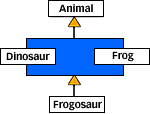 Figure 1. Multiple inheritance in Jurassic Park |
The diamond problem can arise in inheritance hierarchies like the one shown in Figure 1. In fact, the diamond problem gets its name from the diamond shape of such an inheritance hierarchy. One way the diamond problem can arise in the Jurassic Park hierarchy is if both Dinosaur and Frog, but not Frogosaur, override a method declared in Animal. Here's what the code might look like if Java supported traditional multiple inheritance:
abstract class Animal {

    abstract void talk();
}

class Frog extends Animal {

    void talk() {

        System.out.println("Ribit, ribit.");
}

class Dinosaur extends Animal {

    void talk() {
        System.out.println("Oh I'm a dinosaur and I'm OK...");
    }
}

// (This won't compile, of course, because Java
// only supports single inheritance.)
class Frogosaur extends Frog, Dinosaur {
}
The diamond problem rears its ugly head when someone tries to invoke talk() on a Frogosaur object from an Animal reference, as in:
Animal animal = new Frogosaur();
animal.talk();
Because of the ambiguity caused by the diamond problem, it isn't clear whether the runtime system should invoke Frog's or Dinosaur's implementation of talk(). Will a Frogosaur croak "Ribbit, Ribbit." or sing "Oh, I'm a dinosaur and I'm okay..."?
The diamond problem would also arise if Animal had declared a public instance variable, which Frogosaur would then have inherited from both Dinosaur and Frog. When referring to this variable in a Frogosaur object, which copy of the variable -- Frog's or Dinosaur's -- would be selected? Or, perhaps, would there be only one copy of the variable in a Frogosaur object?
In Java, interfaces solve all these ambiguities caused by the diamond problem. Through interfaces, Java allows multiple inheritance of interface but not of implementation. Implementation, which includes instance variables and method implementations, is always singly inherited. As a result, confusion will never arise in Java over which inherited instance variable or method implementation to use.
Interfaces and polymorphism
In my quest to understand the interface, the diamond problem explanation made some sense to me, but it didn't really satisfy me. Sure, the interface represented Java's way of dealing with the diamond problem, but was that the key insight into the interface? And how did this explanation help me understand how to use interfaces in my programs and designs?
As time went by I began to believe that the key insight into the interface was not so much about multiple inheritance as it was about polymorphism (see the explanation of this term below). The interface lets you take greater advantage of polymorphism in your designs, which in turn helps you make your software more flexible.
Ultimately, I decided that the "point" of the interface was:
Java's interface gives you more polymorphism than you can get with singly inherited families of classes, without the "burden" of multiple inheritance of implementation.
A refresher on polymorphism
This section will present a quick refresher on the meaning of polymorphism. If you are already comfortable with this fancy word, feel free to skip to the next section, "Getting more polymorphism."
Polymorphism means using a superclass variable to refer to a subclass object. For example, consider this simple inheritance hierarchy and code:
abstract class Animal {

    abstract void talk();
}

class Dog extends Animal {

    void talk() {
        System.out.println("Woof!");
    }
}

class Cat extends Animal {

    void talk() {
        System.out.println("Meow.");
    }
}
Given this inheritance hierarchy, polymorphism allows you to hold a reference to a Dog object in a variable of type Animal, as in:
Animal animal = new Dog();
The word polymorphism is based on Greek roots that mean "many shapes." Here, a class has many forms: that of the class and any of its subclasses. An Animal, for example, can look like a Dog or a Cat or any other subclass of Animal.
Polymorphism in Java is made possible by dynamic binding, the mechanism by which the Java virtual machine (JVM) selects a method implementation to invoke based on the method descriptor (the method's name and the number and types of its arguments) and the class of the object upon which the method was invoked. For example, the makeItTalk() method shown below accepts an Animal reference as a parameter and invokes talk() on that reference:
class Interrogator {

    static void makeItTalk(Animal subject) {
        subject.talk();
    }
}
At compile time, the compiler doesn't know exactly which class of object will be passed to makeItTalk() at runtime. It only knows that the object will be some subclass of Animal. Furthermore, the compiler doesn't know exactly which implementation of talk() should be invoked at runtime.
As mentioned above, dynamic binding means the JVM will decide at runtime which method to invoke based on the class of the object. If the object is a Dog, the JVM will invoke Dog's implementation of the method, which says, "Woof!". If the object is a Cat, the JVM will invoke Cat's implementation of the method, which says, "Meow!". Dynamic binding is the mechanism that makes polymorphism, the "subsitutability" of a subclass for a superclass, possible.
Polymorphism helps make programs more flexible, because at some future time, you can add another subclass to the Animal family, and the makeItTalk() method will still work. If, for example, you later add a Bird class:
class Bird extends Animal {

    void talk() {

        System.out.println("Tweet, tweet!");
    }
}
you can pass a Bird object to the unchanged makeItTalk() method, and it will say, "Tweet, tweet!".
Getting more polymorphism
Interfaces give you more polymorphism than singly inherited families of classes, because with interfaces you don't have to make everything fit into one family of classes. For example:
interface Talkative {

    void talk();
}

abstract class Animal implements Talkative {

    abstract public void talk();
}

class Dog extends Animal {

    public void talk() {
        System.out.println("Woof!");
    }
}

class Cat extends Animal {

     public void talk() {
        System.out.println("Meow.");
    }
}

class Interrogator {

    static void makeItTalk(Talkative subject) {
        subject.talk();
    }
}
Given this set of classes and interfaces, later you can add a new class to a completely different family of classes and still pass instances of the new class to makeItTalk(). For example, imagine you add a new CuckooClock class to an already existing Clock family:
class Clock {
}

class CuckooClock implements Talkative {

    public void talk() {
        System.out.println("Cuckoo, cuckoo!");
    }
}
Because CuckooClock implements the Talkative interface, you can pass a CuckooClock object to the makeItTalk() method:
class Example4 {

    public static void main(String[] args) {
        CuckooClock cc = new CuckooClock();
        Interrogator.makeItTalk(cc);
    }
}
With single inheritance only, you'd either have to somehow fit CuckooClock into the Animal family, or not use polymorphism. With interfaces, any class in any family can implement Talkative and be passed to makeItTalk(). This is why I say interfaces give you more polymorphism than you can get with singly inherited families of classes.
The 'burden' of implementation inheritance
Okay, my "more polymorphism" claim above is fairly straightforward and was probably obvious to many readers, but what do I mean by, "without the burden of multiple inheritance of implementation?" In particular, exactly how is multiple inheritance of implementation a burden?
As I see it, the burden of multiple inheritance of implementation is basically inflexibility. And this inflexibility maps directly to the inflexibility of inheritance as compared to composition.
By composition, I simply mean using instance variables that are references to other objects. For example, in the following code, class Apple is related to class Fruit by composition, because Apple has an instance variable that holds a reference to a Fruit object:
class Fruit {

    //...
}

class Apple {

    private Fruit fruit = new Fruit();
    //...
}
In this example, Apple is what I call the front-end class and Fruit is what I call the back-end class. In a composition relationship, the front-end class holds a reference in one of its instance variables to a back-end class.
In last month's edition of my Design Techniques column, I compared composition with inheritance. My conclusion was that composition -- at a potential cost in some performance efficiency -- usually yielded more flexible code. I identified the following flexibility advantages for composition:
- It's easier to change classes involved in a composition relationship than it is to change classes involved in an inheritance relationship.
- Composition allows you to delay the creation of back-end objects until (and unless) they're needed. It also allows you to change the back-end objects dynamically throughout the lifetime of the front-end object. With inheritance, you get the image of the superclass in your subclass object image as soon as the subclass is created, and it remains part of the subclass object throughout the lifetime of the subclass.
The one flexibility advantage I identified for inheritance was:
- It's easier to add new subclasses (inheritance) than it is to add new front-end classes (composition), because inheritance comes with polymorphism. If you have a bit of code that relies only on a superclass interface, that code can work with a new subclass without change. This isn't true of composition, unless you use composition with interfaces.
In this last flexibilility comparison, however, inheritance is not as secure as it might seem given its polymorphism advantage. That last clause above, "unless you use composition with interfaces," is very important. Basically, thanks to interfaces, the composition relationship can also bask in the warm glow of polymorphism. Here's an example:
interface Peelable {

    int peel();
}

class Fruit {

    // Return int number of pieces of peel that
    // resulted from the peeling activity.
    public int peel() {

        System.out.println("Peeling is appealing.");
        return 1;
    }
}

class Apple implements Peelable {

    private Fruit fruit = new Fruit();

    public int peel() {
        return fruit.peel();
    }
}

class FoodProcessor {

    static void peelAnItem(Peelable item) {
        item.peel();
    }
}

class Example5 {

    public static void main(String[] args) {

        Apple apple = new Apple();
        FoodProcessor.peelAnItem(apple);
    }
}
Given the above set of classes, you could later define a class Banana like this:
class Banana implements Peelable {

    private Fruit fruit = new Fruit();

    public int peel() {
        return fruit.peel();
    }
}
Like Apple, class Banana has a composition relationship with Fruit. It reuses Fruit's implementation of peel() by explicit delegation: it invokes peel() on its own Fruit object. But a Banana object can still be passed to the peelAnItem() method of class FoodProcessor, because Banana implements the Peelable interface.
As this example illustrates, interfaces allow you to get the best of both worlds. You get the flexibility of composition and the flexibility of polymorphism in one design.
Choosing between composition and inheritance
As I described in last month's article, my basic approach to choosing between inheritance and composition is that I make sure inheritance models a permanent is-a relationship. The is-a relationship means that a subclass is a more specialized form of a superclass (that the superclass is a more general form of the subclass). For example, a SavingsAccount is-an Account. I believe that modeling all (and only) permanent is-a relationships with inheritance helps maximize the code flexibility, because doing so gives inheritance a clear meaning that can help other programmers understand your code.
My main design philosophy is that its primary goal should be to maximize code flexibility, defined as the ease with which code can be understood and changed. Although I state in last month's article that composition in general yields more flexible code than inheritance, I list reasons that show composition yielding code that's easier to change, but not necessarily easier to understand. Inheritance, if you use it just for is-a relationships, gives you the flexibility advantage that your code becomes easier to understand.
My feeling, therefore, is that the way to get maximum advantage of both inheritance and composition in your designs is to ask yourself if you have a permanent is-a relationship. If so, use inheritance. If not, use composition. For more details on this design guideline, read last month's article.
Interface guidelines
Where, then, do interfaces fit into this picture? As I mention above, one major benefit of the Java interface is that they give composition a shot at polymorphism. When you use composition with interfaces, it becomes as easy to add a new front-end class (composition) as it is to add a new subclass (inheritance). But what does this tell us? Should you always use interfaces every time you use composition? Well, no. Should you avoid using interfaces in conjunction with single inheritance of class extension? Certainly not.
As I mentioned at the beginning of this article, it took me a long time to get the point of interfaces. The epiphany finally came when I recognized that separation interface and implementation is one of the primary ideas behind Java in general. The Java virtual machine (JVM), for example, is an abstract computer that defines the way your program "interfaces" with the underlying real computer. A JVM that runs on Windows is one implementation of that abstract computer. A JVM that runs on the Macintosh is another. A JVM that runs on your wristwatch is yet another.
Likewise, the Java APIs are designed not to give you access to specific capabilities of particular computers and operating systems, but define abstract interfaces through which your programs talks to the underlying concrete computer and operating system, whatever it is. Swing, for example, provides an interface through which your Java program can create graphical user interfaces on whatever platform happens to be underneath. You can even use Swing to create user-interfaces on your wristwatch, so long as someone has done the work to implement Swing on your wristwatch.
Separation of interface and implementation is central to Java's spirit, and the Java interface construct enables you to achieve this separation in your designs. Two major activities of any software system design are identifying parts (the subsystems within a program or system of programs) and specifying the interfaces between the parts. In designing a Java-based system, you should use Java interfaces to represent abstract interfaces -- the ways in which the parts will interact with each other.
So this is how I ended up thinking about Java's interfaces: as the preferred means of communicating with the parts of your program that represent abstractions that may have several implementations. For example, two parts of a program I describe in my September Design Techniques installment, "The Event Generator Idiom", were TelephoneListener and Telephone. In this design, I decided that the "telephone listener" represented an abstraction that could have multiple implementations, but that Telephone did not. Thus, I made Telephone a class that didn't implement any interfaces, and defined TelephoneListener as an interface. Telephone, an event source, passed events to (communicated with) listeners through the TelephoneListener interface.
I see interfaces as a fundamental tool for achieving flexibility in the design of Java-based systems. Any class can provide an implementation of an interface. As long as you don't change the interface itself, you can make all kind of changes to the implementing classes, or plug in new classes, without impacting code that depends only on the interface. Thus, if you have a subsystem that represents an abstraction that may have multiple implementations, whether the subsystem is a single object, a group of objects, an entire Java applet or application, you should define Java interfaces through which the rest of the world communicates with that subsystem. When you use interfaces in this way, you decouple the parts of your system from each other and generate code that is more flexible: more easily changed, extended, and customized.
Next month
In next month's Design Techniques article, I'll talk about designing with dynamic extension.
A request for reader participation
I encourage your comments, criticisms, suggestions, flames -- all kinds of feedback -- about the material presented in this column. If you disagree with something, or have something to add, please let me know.
You can either participate in a discussion forum devoted to this material or e-mail me directly at bv@artima.com.
- Bill Venners' next book is Flexible Java
http://www.artima.com/flexiblejava/index.html - Bill Venners just got back from his European bike trip. Read about it at:
http://www.artima.com/bv/travel/bike98/index.html - The discussion forum devoted to the material presented in this article
http://www.artima.com/flexiblejava/fjf/interfaces/index.html - Links to all previous design techniques articles
http://www.artima.com/designtechniques/index.html - Recommended books on Java design
http://www.artima.com/designtechniques/booklist.html - The interfaces chapter from Bill's Course Reader, Objects and Java
http://www.artima.com/innerjava/webuscript/interfaces.html - A transcript of an e-mail debate between Bill Venners, Mark Johnson (JavaWorld's JavaBeans columnist), and Mark Balbe on whether or not all objects should be made into beans
http://www.artima.com/flexiblejava/comments/beandebate.html - Object orientation FAQ
http://www.cyberdyne-object-sys.com/oofaq/ - 7237 Links on Object Orientation
http://www.rhein-neckar.de/~cetus/software.html - The Object-Oriented Page
http://www.well.com/user/ritchie/oo.html - Collection of information on OO approach
http://arkhp1.kek.jp:80/managers/computing/activities/OO_CollectInfor/OO_CollectInfo.html - Design Patterns Home Page
http://hillside.net/patterns/patterns.html - A Comparison of OOA and OOD Methods
http://www.iconcomp.com/papers/comp/comp_1.html - Object-Oriented Analysis and Design Methods: A Comparative Review
http://wwwis.cs.utwente.nl:8080/dmrg/OODOC/oodoc/oo.html - Patterns discussion FAQ
http://gee.cs.oswego.edu/dl/pd-FAQ/pd-FAQ.html - Patterns in Java AWT
http://mordor.cs.hut.fi/tik-76.278/group6/awtpat.html - Software Technology's Design Patterns Page
http://www.sw-technologies.com/dpattern/ - Previous Design Techniques articles
http://www.javaworld.com/topicalindex/jw-ti-techniques.html
This article was first published under the name Designing with Interfaces in JavaWorld, a division of Web Publishing, Inc., November 1998.
Talk back!
Have an opinion? Be the first to post a comment about this article.
About the author
Bill Venners has been writing software professionally for 12 years. Based in Silicon Valley, he provides software consulting and training services under the name Artima Software Company. Over the years he has developed software for the consumer electronics, education, semiconductor, and life insurance industries. He has programmed in many languages on many platforms: assembly language on various microprocessors, C on Unix, C++ on Windows, Java on the Web. He is author of the book: Inside the Java Virtual Machine, published by McGraw-Hill.

Artima provides consulting and training services to help you make the most of Scala, reactive
and functional programming, enterprise systems, big data, and testing.
2070 N Broadway Unit 305
Walnut Creek CA 94597
USA
(925) 918-1769 (Phone)